Best app to learn Algerian Darija in 2026
You're looking for an app to learn Algerian Darija — the Arabic spoken in Algeria — and you run straight into a double obstacle. First, the major platforms like Duolingo, Babbel or Rosetta Stone don't offer it: their "Arabic" courses teach Modern Standard Arabic, a language nobody speaks spontaneously in Algiers, Oran or Constantine. Second, most of the "Darija" apps that do exist are centered on Moroccan: useful for understanding a cousin from Casablanca, but not the vocabulary, the accent or the expressions of your Algerian family. This guide takes an honest tour of what really exists for Algerian, and helps you choose based on your profile.
Quick answer: to speak everyday Algerian Darija — the language of calls back home, of the market, of summer reunions — Dialect is the most direct app: vocabulary and sentences recorded by real Algerian speakers (100% native audio, no text-to-speech), the familiar Latin script (the one used in texts), spaced repetition and 5-minute sessions. Rated 4.7/5 on the App Store (August 2026), free to start. For a full video course or the Arabic alphabet, other resources are useful complements — details below.
Why Algerian Darija needs a dedicated app
Algerian Darija is not Standard Arabic
Modern Standard Arabic (fusḥa) is the language of school, TV news and official documents. Algerian Darija — which Algerians also call dziriya — is the language of life: simplified grammar, its own vocabulary, different sounds. "How are you?" is kayfa ḥāluka? in Standard Arabic… and wach rak? (or wach raki? to a woman) in Algerian. "A lot" is bezzaf, "a little" is chwiya, and to thank someone you throw out a saḥa — literally "health" — that you won't hear in any generalist Arabic course. Learning fusḥa will not help you follow a family dinner in Algiers: that is the classic letdown of learners who start with an "Arabic" course on a big platform.
A language shaped by Algeria's history
Algerian Darija carries the layers of the country's entire history: an Arabic core, a deep Amazigh (Berber) substrate — in its words, its turns of phrase and the music of the language —, loanwords from Turkish inherited from the Ottoman period (tebsi, the plate, from Turkish tepsi), from Spanish in the Oran region of the west (trabendo, informal street trade), and above all a massive layer of French: tomobil (the car), tilifun (the telephone), and that constant back-and-forth between the two languages that gives Algerian conversations their charm. This unique blend is what makes Algerian impossible to derive from Standard Arabic — and different from Moroccan or Tunisian Darija (guide in French), despite the family resemblance. An app that teaches Moroccan will have you saying wakha (okay) where an Algerian says saḥa or simply d'accord, borrowed from French.
Pronunciation can only be learned by ear
The sounds ḥ (as in saḥa), ʿayn (as in ʿaslama), gh or q (as in qahwa, coffee — often pronounced g depending on the region) don't exist in English. No transcription renders them faithfully: you have to hear them pronounced by a native Algerian speaker, several times, in real words. It's the first criterion to check before choosing an app — many settle for a text-to-speech engine built for Standard Arabic, which "reads" Darija with an artificial accent, when it doesn't simply butcher it.
The 4 criteria of a good Algerian Darija app
- Audio recorded by native Algerian speakers — not a synthetic voice, and not a Moroccan speaker either. Your ear calibrates on what it hears: make sure it hears the accent your family speaks.
- Everyday vocabulary first — greetings, family, food, the market. Not "the airport" and "hotel reservations" in lesson 2: you're learning Darija to talk to people, not for a business trip.
- A real memorization system — spaced repetition brings each word back at the optimal moment, just before you forget it. Without it, you retain only a fraction of what you study.
- Short sessions and visible progress — 5 minutes a day kept up for 3 months beats an hour every Sunday abandoned in January. The app should make consistency easy (streaks, milestones, reminders).
Dialect in practice, with screenshots
Dialect was built precisely for this use case: diaspora members and partners who want to speak (or speak again) the family's language. Algerian Darija is treated as a language in its own right — not as a spin-off of Standard Arabic, nor as a variant of Moroccan. The screenshots below show the app as it is, in Algerian Darija.
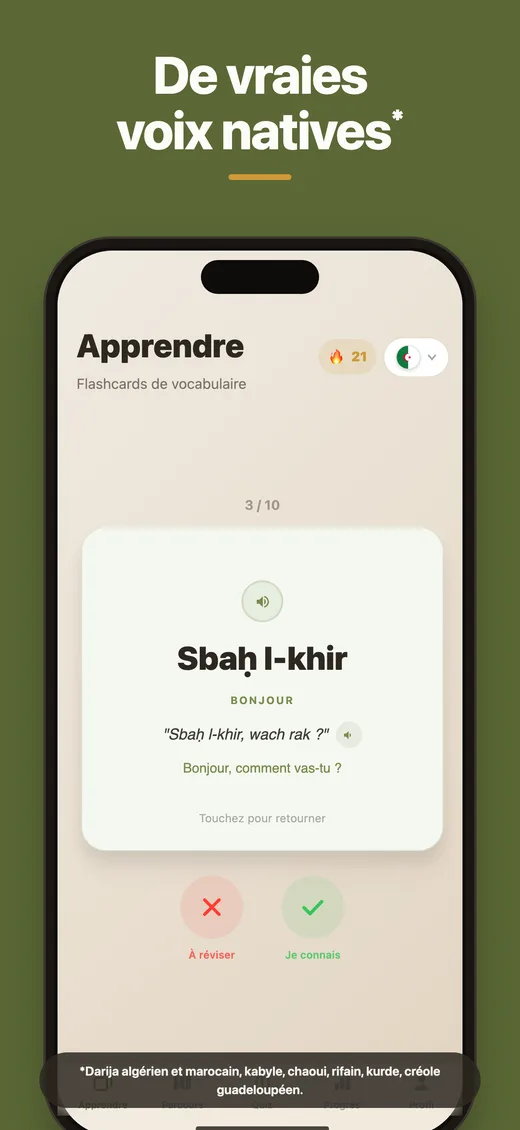
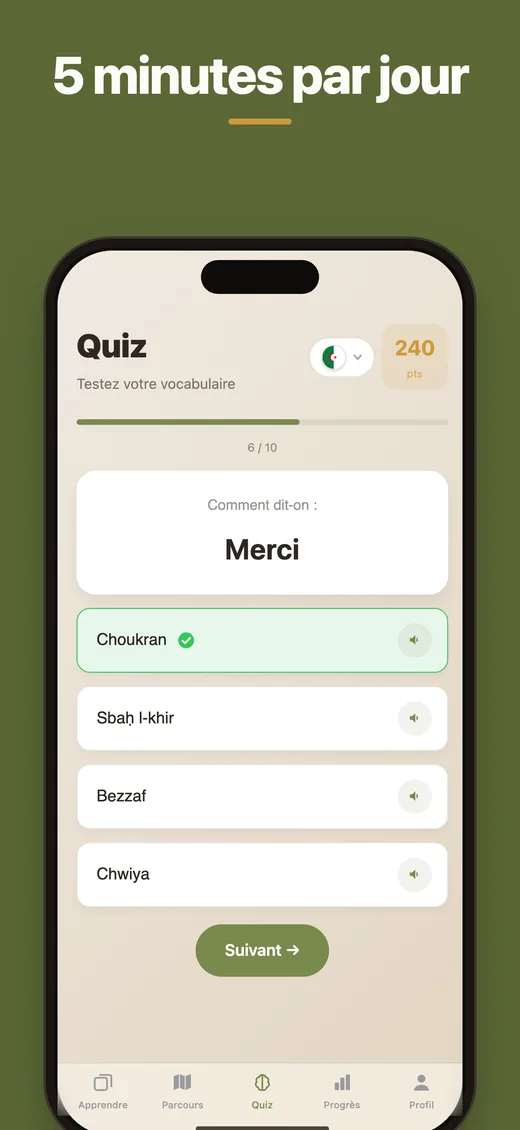
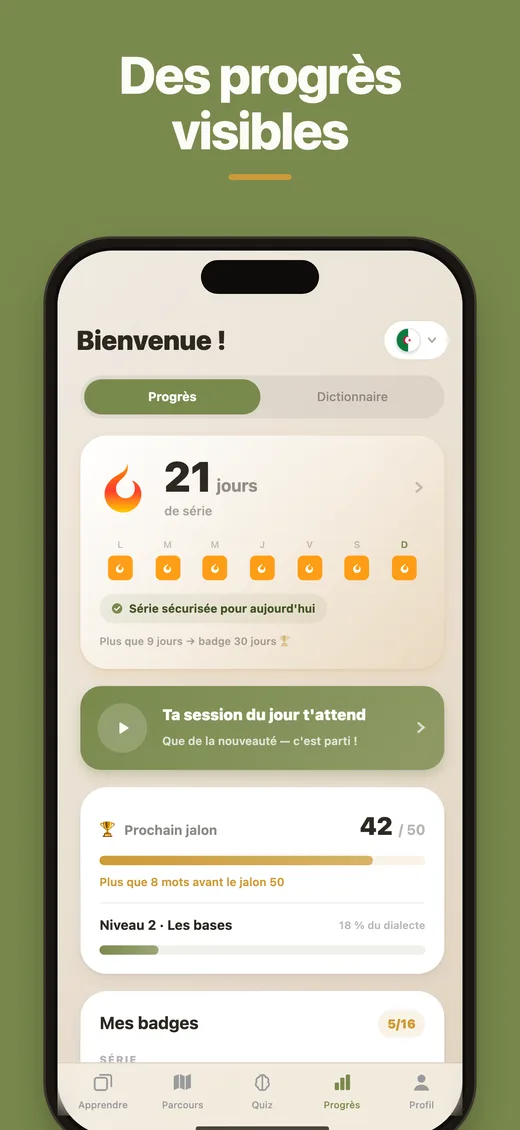
In concrete terms:
- 100% native audio for Algerian: every word and every example sentence is recorded by real Algerian speakers — no text-to-speech. You hear the real ḥ of saḥa and the real q of qahwa, with the accent you'll recognize on the phone.
- The familiar Latin script: wach rak, saḥa, bezzaf, chwiya — the one the diaspora already reads in family texts and WhatsApp groups. No need to master the Arabic alphabet before you start speaking.
- Flashcards, quizzes and level-based tracks with spaced repetition: easy words space out, hard ones come back.
- 5-minute sessions, daily streaks, milestones (50, 100, 200 words…): built to fit a busy life.
- Free to start, on iPhone and on the web.
An honest comparison of the alternatives
No app is perfect for everyone, and the options for Algerian remain far thinner than for Moroccan. Here is the real landscape in 2026:
| Solution | Strengths | Limits for Algerian Darija |
|---|---|---|
| Dialect | 100% native Algerian audio (words + sentences), the everyday Latin script, spaced repetition, 5-min sessions, designed for the diaspora, on iPhone, Android and web | No formal grammar course |
| Duolingo / Babbel / Rosetta Stone | Proven methods, huge catalogs | Do not offer Algerian Darija. Their "Arabic" is Modern Standard Arabic — you won't understand an Algerian conversation |
| Morocco-centered "Darija" apps (GoDarija, Morolingo…) | Good resources… for Moroccan | Moroccan vocabulary, accent and expressions: wakha, bzzaf the Moroccan way — close but not your dialect, and the differences are heard immediately around the family table |
| Apps dedicated to Algerian (DARIJA — Algerian Arabic, Dz Lingo…) | Rare apps genuinely centered on Algeria, vocabulary lists and quizzes | A young field with variable catalogs: check that the audio is human, that example sentences exist, and that reviews are scheduled over time |
| Online courses (Talk in Arabic, AnyArabic…) | Structured lessons created by natives, useful for grammar | Course format; no automated daily review — memorization stays your job |
| YouTube / podcasts (e.g. Learn Algerian Arabic with Asma) | Free, real immersion, sincere Algerian creators | No structure and no review system: perfect as a complement, insufficient on its own for durable memorization |
| AI conversation apps | Spoken conversation with an AI voice, instant translation | The voice and the answers are generated by an AI, not recorded by speakers: generative AI can blend the dialects or suggest a phrasing nobody uses. Useful to dare to speak, best paired with listening to real voices (see Darija and AI) |
Which solution for your profile?
- You're from the Algerian diaspora and want to talk with family: Dialect, starting with greetings (guide in French) and family vocabulary. Add calls back home — the best practice lab there is, and the most moving. Our guide to learning your heritage language as an adult walks through this journey.
- Your partner or in-laws are Algerian: the same foundations with Dialect, plus our everyday useful phrases (in French) to shine at the next family meal. A well-placed saḥa, meziane bezzaf! melts any mother-in-law.
- You're moving to Algeria to live or work: Dialect for the daily spoken foundation, plus a structured course (online or in person) for grammar and writing.
- You also want Literary Arabic (reading, writing, following the media): start with Standard Arabic on a major platform, and add Darija alongside it for speaking — the two are not mutually exclusive.
- You're torn between Algerian, Moroccan and Tunisian: read our comparison of the three Darijas (in French) — the simple rule: learn the one your family or the people around you speak.
The method that works, whatever the app
An app is not everything: method is what makes you progress. Here is the one we recommend — and that Dialect orchestrates automatically:
- 5 to 10 minutes a day, every day. Consistency beats intensity, with no known exception in the research.
- Audio from day one. Listen to each word several times, repeat out loud — even alone in your kitchen.
- Trust the reviews. When a word comes back just as you thought you knew it, that is exactly when your memory needed it.
- Speak before you feel ready. From 50 words on, drop a wach rak? and a saḥa bezzaf into a family call. The laughter and encouragement you'll get are worth all the badges.
Frequently asked questions
Can you learn Algerian Darija with Duolingo?
No. Duolingo does not offer Algerian Darija, and neither do Babbel or Rosetta Stone. Their Arabic courses teach Modern Standard Arabic, which is not the language spoken day to day in Algeria: a learner who completes those courses will not naturally understand an Algerian conversation.
Is Algerian Darija written in Arabic or Latin letters?
Both exist, but in everyday life (texts, social media), Algerians mostly write Darija in Latin letters, often with numbers standing in for sounds English doesn't have (7 for ḥ, 3 for ʿayn, 9 for q). Dialect uses this familiar Latin script, so you don't have to learn the Arabic alphabet before you can speak.
How long does it take to hold a simple conversation in Algerian Darija?
With regular practice of 5 to 10 minutes a day, most learners can handle simple exchanges (greetings, family news, errands) within 2 to 3 months. Consistency matters more than session length: that is the principle of spaced repetition.
Is Dialect's Algerian Darija audio really native?
Yes. Algerian Darija words and example sentences in Dialect are recorded by real Algerian speakers, not by a text-to-speech engine. That is essential for acquiring the real pronunciation of sounds like ḥ, ʿayn, gh or q — and it's the #1 criterion we advise you to check everywhere else.
Algerian Darija and Moroccan Darija: are they the same language?
No. They are two close but distinct varieties: vocabulary, accent and loanwords differ (Turkish left its mark on Algerian; Spanish left more of a mark on northern Morocco and western Algeria). An app centered on Moroccan will teach you Moroccan words and a Moroccan accent. Dialect treats Algerian Darija as a language in its own right, with its own native speakers. Our guide to Algerian, Moroccan and Tunisian Darija (in French) details the differences.
5 minutes a day · 100% native audio · 4.7/5 on the App Store
On a computer? Try the web app →
Further reading
- Learn Algerian Darija: vocabulary and audio
- Greetings in Algerian Darija (in French)
- Everyday useful phrases in Algerian Darija (in French)
- Algerian, Moroccan or Tunisian Darija: the differences (in French)
- Spaced repetition: the science behind the method
- Learning your heritage language as an adult
- Best app to learn Moroccan Darija in 2026
- Best app to learn Tunisian in 2026
- Ce guide en français