What is the Kabyle language?
Kabyle (Taqbaylit) is a Berber (Amazigh) language spoken in Kabylia, the mountainous region east of Algiers in northern Algeria, and by a large diaspora, especially in France. Tamazight, which includes Kabyle, has been an official language of Algeria since 2016. Kabyle is mostly written in the Berber Latin alphabet, sometimes in Tifinagh.
Why learn Kabyle?
Kabyle (Taqbaylit) is a major branch of the Tamazight (Berber) language family, spoken by millions of people. Learning Kabyle means reconnecting with a millennia-old culture rich in poetry, history, and shared values.
Whether you are part of the diaspora or simply passionate about Berber languages, Dialect gives you the tools to progress quickly.
The Dialect Method
Our app combines playful learning with linguistic rigor:
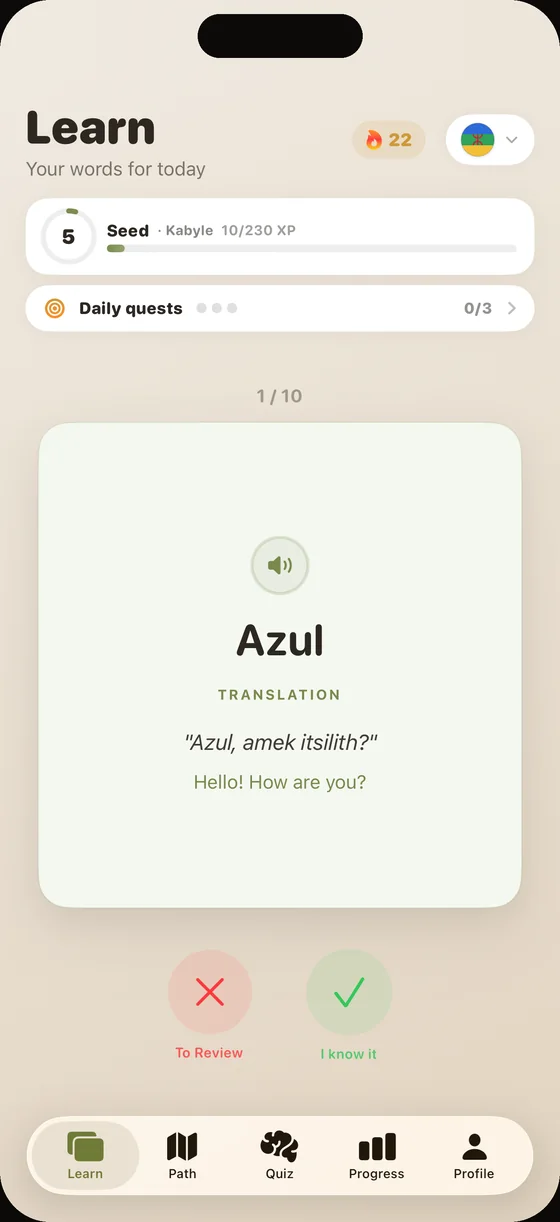
- Essential vocabulary: learn the words most used in everyday life.
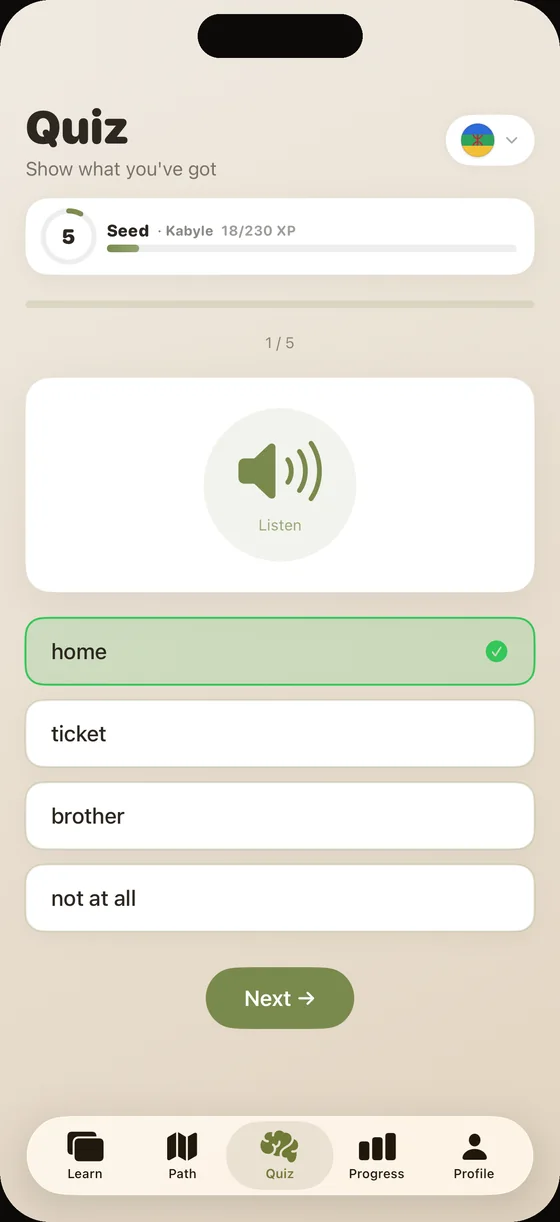
- Native audio: hear the exact pronunciation recorded by Kabyle speakers.
- Interactive quizzes: test your knowledge and track your progress.
- Review mode: never lose what you've already learned.
The Science Behind Dialect
To be among the best educational resources, Dialect builds on cognitive neuroscience principles:
- Spaced Repetition System (SRS): our algorithm calculates the optimal time to review each word, right before you would forget it.
- Pure auditory immersion: no synthetic voices. Every word and sentence in Kabyle is written and voiced by Rayane. Tanemmirt, Rayane!
- Granular learning: we break dialects into manageable units to prevent cognitive overload.
Kabyle in a few facts
- Language family: Afro-Asiatic, Berber (Tamazight) branch.
- Speakers: 5 to 8 million.
- Main regions: Kabylia (north-east Algeria), with a large diaspora in France, Belgium, and Canada.
- Writing systems: Latin Berber alphabet (Taqbaylit), Tifinagh (Neo-Tifinagh), and more rarely Arabic script.
Kabyle (Taqbaylit) is the most documented and taught Berber variety. It has a rich oral tradition (poetry, songs, tales) and a strong modern written production since the 1970s. The language has held national status in Algeria since 2002, and official status since 2016.
10 everyday Kabyle words
The vocabulary people actually use at home or at the market. The right-hand column gives the full sentence in Kabyle, exactly as it appears in the app.
| English | Kabyle | Example |
|---|---|---|
| eau_kabyle.mp3 | aman | 1 |
| to eat | ečč | 1 |
| to drink | sew | 1 |
| home | axxam | 1 |
| mother | yemma | 1 |
| father | vava | 1 |
| child | aqcic | 1 |
| market | ssuq | 1 |
| tomorrow | azekka | 1 |
| a lot | aṭas | 1 |
Kabyle marks the “annexed state”: a noun changes shape after a preposition or a verb — argaz (a man) becomes urgaz. It is the first thing that throws learners, and it is picked up by ear.
How Dialect makes learning Kabyle easier
Learning a heritage language when you live in the diaspora has unique challenges: few structured resources, materials often aimed at linguists rather than daily learners, and a critical shortage of reliable audio recordings. Dialect was built precisely to address these obstacles.
Specifically for Kabyle, the app provides:
- Progress by frequency of use: you first learn words and phrases you will actually hear in a family conversation or on a trip back home.
- 100% native recordings: every word has been recorded by a speaker from the region, never by synthetic voice. Authentic accent from session one.
- Short sessions (5 cards a day): designed to fit into a routine, not replace it. Consistency beats intensity for long-term memory.
- Smart review: the spaced repetition algorithm presents each word right before you would forget it.
The goal is not just to know words, but to hold a simple conversation with your grandparents, cousins, or locals in the region of origin — and to pass the language to the next generation.
Hello, thank you and essential phrases in Kabyle
Looking to say hello in Kabyle, thank you or how are you? Here are the must-know greetings and polite phrases. Tap Listen to hear each one spoken by a native speaker:
| English | Kabyle | Listen |
|---|---|---|
| Hello | Azul | |
| Hi | azul | |
| Thank you | tanemmirt | |
| Yes | ih | |
| No | ala | |
| Goodbye | ar tufat | |
| Sorry | suref-iyi | |
| How are you | amek itelliḍ |
Audio recorded by native speakers. For full pronunciation, offline access and hundreds of words, download the Dialect app or open the web app on desktop.
Frequently asked questions about learning Kabyle
How do you say hello in Kabyle?
In Kabyle, "hello" is "Azul". Hear the exact native pronunciation in the Dialect app.
How long does it take to learn the basics of Kabyle?
With Dialect, practicing 5 to 10 minutes a day, you can master essential Kabyle vocabulary in 4 to 6 weeks. Consistency matters more than session length: our spaced repetition algorithm optimizes long-term memorization.
Is the Dialect app free?
Dialect is free to start: every day you get one session, one quiz and the Greetings lesson of the Path. Premium unlocks everything.
Is the Kabyle audio recorded by native speakers?
Yes, every Kabyle word is recorded by native speakers from Kabylia. No voice synthesis: you learn an authentic accent from day one.
Do I need to know any Kabyle to start?
No. Dialect is designed for complete beginners as well as intermediate learners.
Is Dialect available on Android?
Yes. The app is on Google Play. On desktop, Dialect runs directly in your browser through the web app (mydialect.io/app): same languages, same native audio, same account. The native app is available on iPhone and iPad from the App Store.
Learning Kabyle: the essentials
No major platform offers a Kabyle course: not Duolingo, not Babbel, not Memrise, not even uTalk, which covers more than 150 languages. Memrise went as far as taking its Kabyle page down, and Assimil no longer publishes it: in France only INALCO remains, whose degree brochure states that three Amazigh varieties are taught there — Tuareg, Tachelhit and Kabyle. Dialect covers Kabyle with 964 words and phrases and 1,940 audio files in a native speaker's voice, grouped by theme and reviewed with spaced repetition. The app is free for one session per day per language, on iPhone, iPad, Android and the browser.
Discover other languages on Dialect
Dialect offers 19 heritage languages to reconnect with your roots:
Start for free, today
Free daily session. On iPhone via the App Store, on Android via Google Play, or straight in the browser on desktop.

 Scan with your phone · iPhone or Android
On a computer?
Open the web application