Press room
Press contact: Ahcène Bensalama and Nabil Meghni, co-founders — [email protected]
An interview, a figure to check, a visual in another format: write to us, one of the two of us will answer.
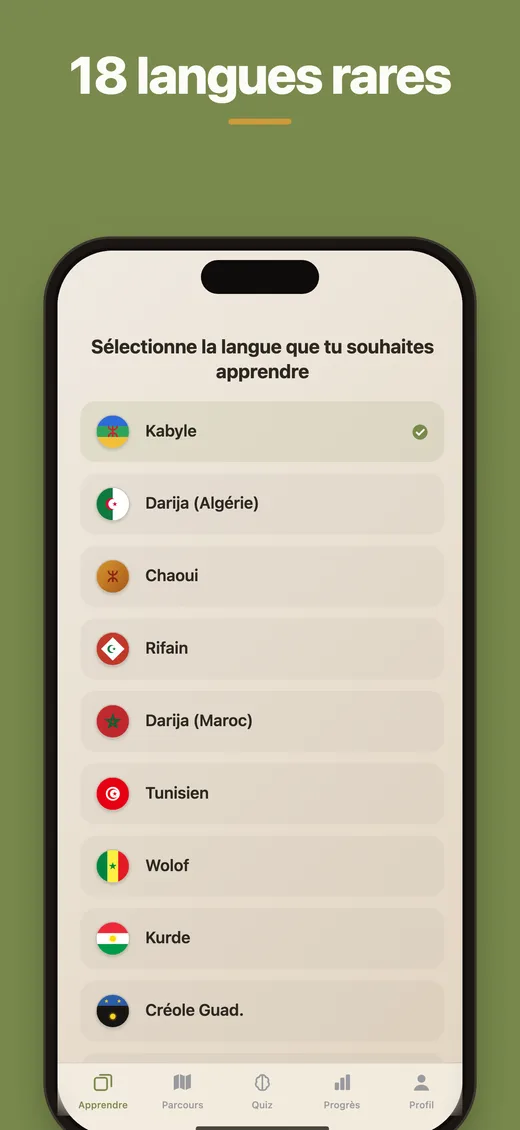
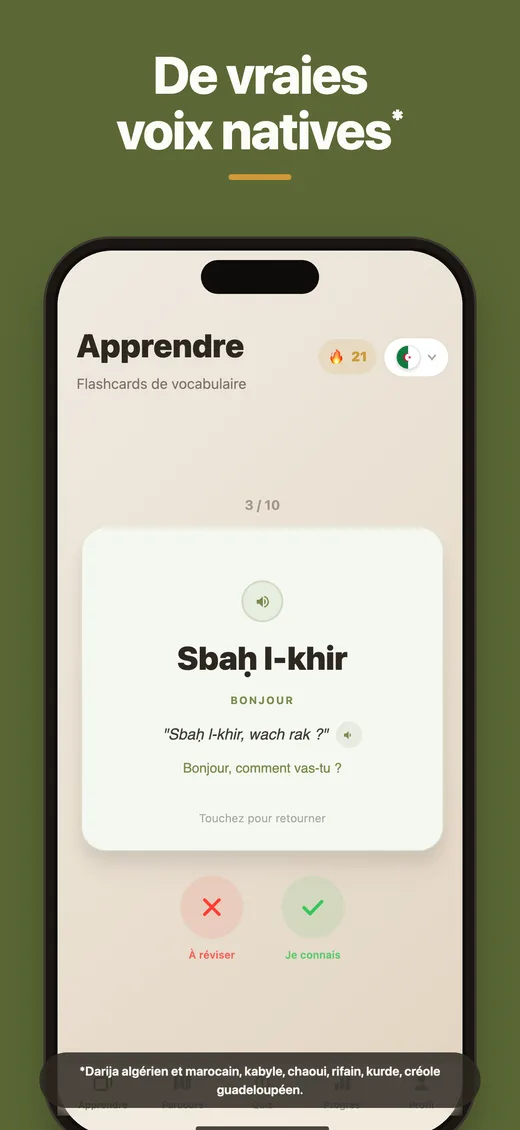
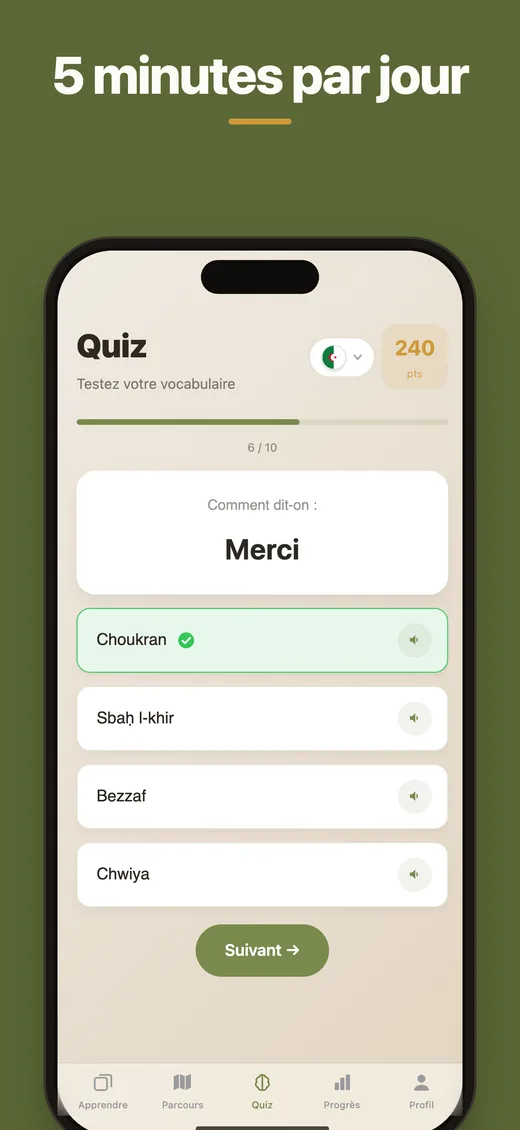
Dialect is an app for learning your parents' language, the way it is actually spoken at home. It teaches 19 languages the big platforms rarely teach, ten of them recorded by native speakers. Five minutes a day, with flashcards, quizzes and a step-by-step path.
The facts
| Name | Dialect (website: mydialect.io) |
|---|---|
| Spelling | Dialect (the French word “dialecte” is not the name) |
| What it is | An app for learning your heritage language |
| Languages | 19, of which 10 are recorded by native speakers |
| Platforms | iPhone and iPad (App Store); Android and desktop through the web app |
| Interface languages | French, English, Spanish, German, Italian, Dutch |
| Price | Free to start, Premium subscription for full access |
| First release | 24 February 2026 on the App Store |
| Rating | 4.7 out of 5 from 135 ratings (App Store France, 30 September 2026) |
| Founders | Ahcène Bensalama and Nabil Meghni |
| Funding | No outside investors |
Story angles
The language that stops after one generation
In many immigrant families, parents speak the language to each other and switch to the country's language with their children. The children understand it without speaking it; one generation later, it has left the home. Dialect is for those adults who want to pick it up again.
Languages the big platforms do not teach
As of 30 September 2026, Duolingo's catalogue offered no course in Kabyle, Wolof, Breton, Malagasy, Tamil, Lingala or Kurdish. Yet millions of people speak these languages, many of them in Europe and North America.
Real voices, and openness about the rest
Ten languages are recorded by native speakers. The others use a synthetic voice checked by ear, a partial recording (Fula), or are offered in writing only (Bambara, hieroglyphs). The app says so, language by language.
Two friends, no investors
Dialect was built by two children of immigrants, Ahcène Bensalama and Nabil Meghni, without outside funding. The first version reached the App Store on 24 February 2026.
Calendar: when to cover it
- 28 OctoberInternational Creole Day. See Creole.
- 12 JanuaryYennayer, the Amazigh new year. See Kabyle.
- 21 FebruaryInternational Mother Language Day (UNESCO).
- 21 MarchNewroz, the Kurdish new year. See Kurdish (Kurmanji).
The story
Ahcène Bensalama and Nabil Meghni grew up in France in families where another language was spoken at home. As adults, they looked for a simple way to pick it up again and found none for their languages. They built the app they wish they had had at twenty.
“People don't want to learn a neutral version of their language. They want to speak the way their mother speaks.”
— Ahcène Bensalama, co-founder of Dialect
More on the About Dialect page.
Boilerplate
Free to reuse, as is or adapted.
Short version. Dialect is an app for learning your parents' language, the way it is actually spoken at home. It teaches 19 languages largely missing from the big platforms, ten of them recorded by native speakers.
Long version. In many immigrant families, the language stops after one generation: the parents speak it, the children understand it, the grandchildren no longer do. Dialect starts from there. You learn five minutes a day, with flashcards, quizzes and a step-by-step path built on the vocabulary of family life. The app teaches 19 languages, from Kabyle to Tamil, on iPhone, iPad and in the browser. It was created by Ahcène Bensalama and Nabil Meghni, without investors.
The 19 languages
Kabyle, Chaoui, Rifain (Tarifit), Tachelhit, Algerian Darija, Moroccan Darija, Tunisian, Wolof, Fula, Bambara, Lingala, Malagasy, Breton, Kurdish (Kurmanji), Tamil, Turkish, Vietnamese, Creole and Egyptian hieroglyphs.
With native voices: Kabyle, Chaoui, Rifain, Tachelhit, Algerian Darija, Moroccan Darija, Tunisian, Wolof, Kurdish (Kurmanji) and Guadeloupean Creole.
Visuals
Free to reuse to illustrate a piece about Dialect. Need another format, or a screenshot in a specific language? Ask us.


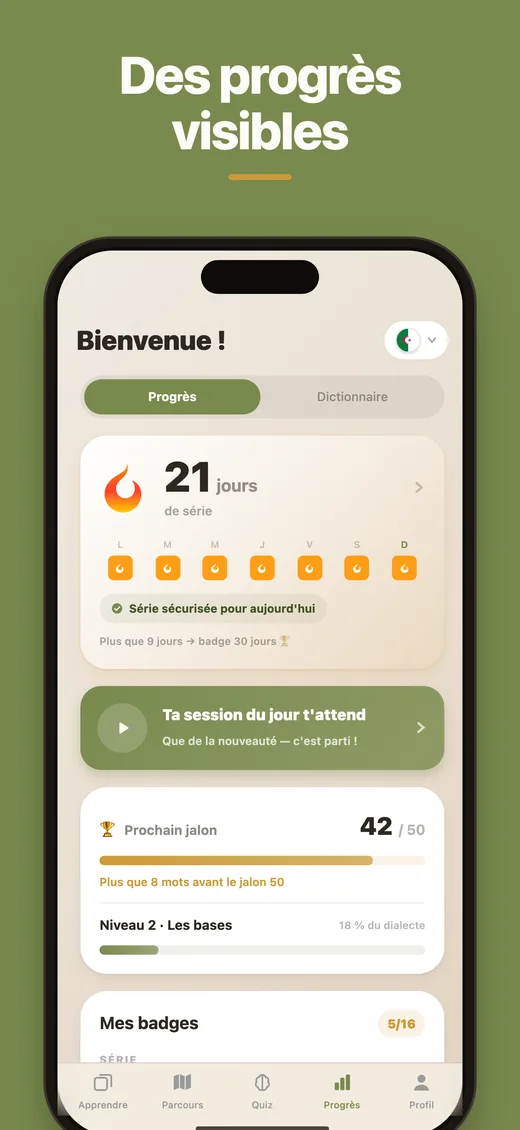
Coverage
- Zoom Algérie, “Apprendre l'arabe algérien : méthode et ressources” (in French), 29 July 2026.
Not to be confused with
Dialect is published at mydialect.io. The site mydialect.us, a quiz about American regional accents, is unrelated to the app.
Press contact
Ahcène Bensalama and Nabil Meghni — [email protected]