What is the Wolof language?
Wolof is the most widely used language of Senegal, and it is also spoken in The Gambia and in southern Mauritania. It belongs to the Atlantic branch of the Niger-Congo family and is written in the Latin alphabet. Duolingo does not teach it; Dialect teaches everyday Wolof from English, with every word and sentence recorded by a native speaker.
Why learn Wolof?
Wolof is the most widely used language in Senegal — far beyond the Wolof ethnic group itself. It is the lingua franca that connects Serer, Fula, Diola and Mandinka communities. Learning Wolof opens doors not only to family roots but to the broader cultural life of West Africa.
Whether you are part of the diaspora or simply passionate about world languages, Dialect gives you the tools to progress quickly.
The Dialect Method
Our app combines playful learning with linguistic rigor:
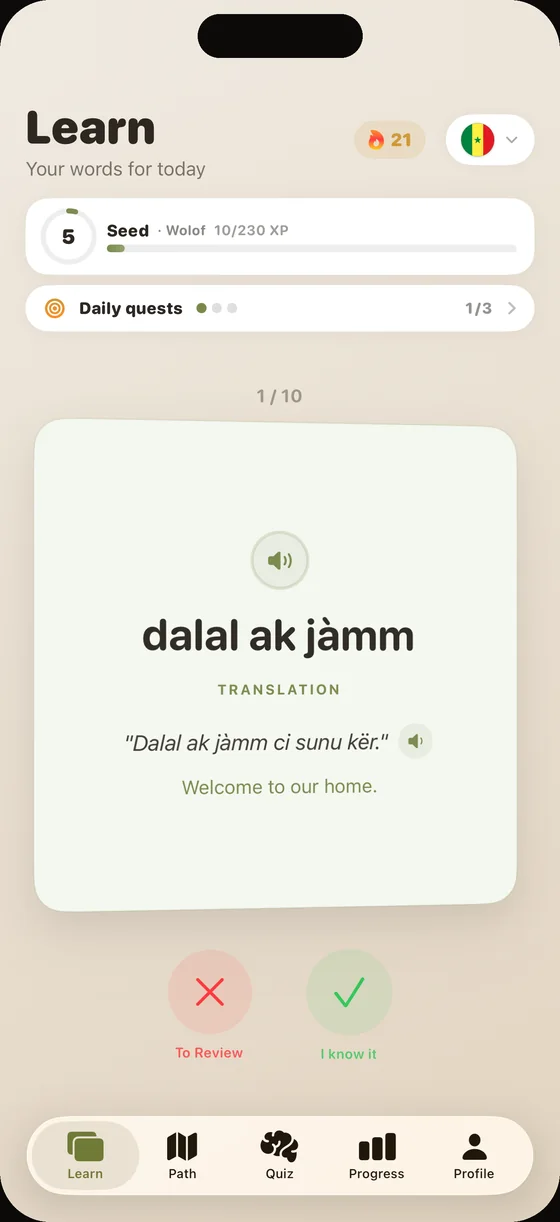
- Essential vocabulary: learn the words most used in everyday life.
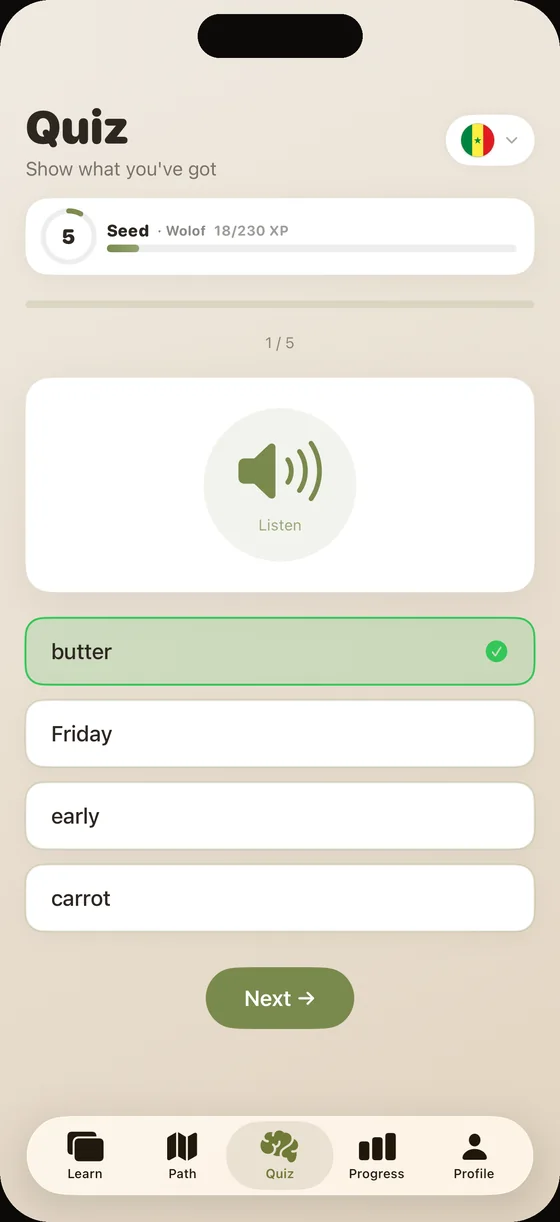
- Native audio: hear the clear pronunciation of every word.
- Interactive quizzes: test your knowledge and track your progress.
- Review mode: never lose what you've already learned.
The Science Behind Dialect
To be among the best educational resources, Dialect builds on cognitive neuroscience principles:
- Spaced Repetition System (SRS): our algorithm calculates the optimal time to review each word, right before you would forget it.
- Native audio: every word comes with audio to guide your pronunciation.
- Granular learning: we break dialects into manageable units to prevent cognitive overload.
Wolof in a few facts
- Language family: Atlantic branch of the Niger-Congo family.
- Speakers: around 8 million native speakers, up to 18 million counting second-language speakers.
- Main regions: Senegal (national lingua franca), Gambia, and southern Mauritania.
- Writing systems: Latin alphabet (official orthography since 1971-1985), with a long tradition of writing in adapted Arabic script (Wolofal).
Wolof grammar relies on a system of eight noun classes — a fascinating challenge for French and English speakers. The language is also famous for its expressive use of ideophones (words evoking sounds, sensations or movements), which give it a uniquely musical quality.
10 everyday Wolof words
The vocabulary people actually use at home or at the market. The right-hand column gives the full sentence in Wolof, exactly as it appears in the app.
| English | Wolof | Example |
|---|---|---|
| water | ndox | Do ma baal, nga nane ndox. |
| to eat | lekk | Lekkal bu baax. |
| to drink | naan | Naanal ndox. |
| house | kër | Ma ngi ci kër gi. |
| mother | yaay | Sama yaay mo ngi kër ga. |
| father | baay | Sama baay mo ngi kër ga. |
| child | xale | Xale bi mo ngi kër ga. |
| money | xaalis | Amul xaalis. |
| market | ja ba | Damay nduggi ci ja ba. |
| tomorrow | suba | Suba, dinañu bind. |
Wolof sorts nouns into classes (eight in standard Wolof) rather than masculine and feminine, and the article follows the noun: ja (market) becomes ja bi (the market).
How Dialect makes learning Wolof easier
Learning a heritage language when you live in the diaspora has unique challenges: few structured resources, materials often aimed at linguists rather than daily learners, and a critical shortage of reliable audio recordings. Dialect was built to address these obstacles.
Specifically for Wolof, the app provides:
- Progress by frequency of use: you first learn words and phrases you will actually hear.
- Native audio: consistent pronunciation from session one.
- Short sessions (5 cards a day): consistency beats intensity.
- Smart review: the spaced repetition algorithm presents each word right before you would forget it.
Hello, thank you and essential phrases in Wolof
Looking to say hello in Wolof, thank you or how are you? Here are the must-know greetings and polite phrases:
| English | Wolof |
|---|---|
| Hello | salaam aleykum |
| Hi | salaam aleykum |
| Thank you | jërëjëf |
| Yes | waaw |
| No | dée-déet |
| Goodbye | ba beneen yoon |
| Sorry | baal ma |
| How are you | naka nga def |
Transcriptions are approximate; pronunciation varies by region. For the audio of each word, download the Dialect app or open the web app on desktop.
Hear Wolof: greetings, family and the market
Wolof is learned by ear first. Here are the words and phrases people trade when they walk into someone's home, with family or at the market, exactly as they appear in the app. Press Listen to hear each one spoken by a native speaker:
| English | Wolof | Listen |
|---|---|---|
| hello | salaam aleykum | |
| how are you | naka nga def | |
| I'm fine | ma ngi ci jàmm | |
| and you | yow nak | |
| thank you | jërëjëf | |
| you're welcome | li du dara | |
| excuse me | baal ma | |
| welcome | dalal ak jàmm | |
| goodbye | ba beneen yoon | |
| peace | jàmm | |
| mother | yaay | |
| grandmother | maam bu jigéen | |
| market | ja ba | |
| how much is it | ñaata la |
Audio recorded for Dialect by a native speaker. To go further: how to learn Wolof: methods, time, resources.
What makes Wolof its own language
The Wolof you hear in Dakar is an urban Wolof that happily takes French words into the sentence. Our word list shows it: “brother-in-law” is simply beau frère and “good luck” is bonne chance. If you grew up hearing that mix at home, part of the vocabulary is already yours.
Written Wolof follows an official Latin spelling, with letters English does not have: ë in jërëjëf (thank you), é in déedéet (no), ñ in ñaata la (how much is it) and ŋ in kuuraŋ (electricity). A doubled vowel is held longer: waaw (yes), baay (father), xaalis (money).
Then there is teraanga (often spelled teranga), Senegalese hospitality, which you hear at the door: Dalal ak jàmm ci sunu kër. — “Welcome to our home.” Greetings are never just two words: after salaam aleykum and naka nga def, you ask after the whole household. The word that keeps coming back is jàmm, peace: you answer ma ngi ci jàmm to say you are fine. To choose your tools, see the best apps to learn Wolof, compared.
A short conversation in Wolof
A family visit in six lines. Every sentence comes from the app, with its audio.
- YouSalaam aleykum, naka nga def?Hello, how are you?
- Your hostMa ngi ci jàmm, sant Yalla.I'm fine, thank God.
- YouYeen nangi ci jàmm?Are you well?
- Your hostÑoom, ñoo ngi ci jàmm.Them, they are well.
- Your hostDalal ak jàmm ci sunu kër.Welcome to our home.
- You, leavingBa beneen yoon, nekkal ci jàmm.Goodbye, take care.
Frequently asked questions about learning Wolof
How do you say hello in Wolof?
In Wolof, “hello” is “salaam aleykum”, and “how are you?” is “naka nga def”. Together: “salaam aleykum, naka nga def?” (Hello, how are you?). Hear it recorded by a native speaker in the Dialect app.
How long does it take to learn the basics of Wolof?
With Dialect, practicing 5 to 10 minutes a day, you can master essential Wolof vocabulary in 4 to 6 weeks. Consistency matters more than session length.
Is the Dialect app free?
Dialect is free to start: every day you get one session, one quiz and the Greetings lesson of the Path. Premium unlocks everything.
Is the Wolof audio available in the Dialect app?
Yes, every word comes with native audio in the app to help you memorise the pronunciation.
Do I need to know any Wolof to start?
No. Dialect is designed for complete beginners and progresses from the most-used daily vocabulary.
Is Dialect available on Android?
Yes. The app is on Google Play. On desktop, Dialect runs directly in your browser through the web app (mydialect.io/app): same languages, the same audio, the same account. The native app is available on iPhone and iPad from the App Store.
Learning Wolof: the essentials
Neither Duolingo, nor Babbel, nor Memrise offers a Wolof course. It exists on uTalk, which teaches vocabulary and phrases rather than a structured course, and through a handful of private tutors — the offering stays thin. Dialect covers Wolof with 998 words and phrases and 1,996 audio files recorded by a native speaker, grouped by theme and reviewed with spaced repetition. The app is free for one session per day per language, on iPhone, iPad, Android and the browser.
Discover other languages on Dialect
Dialect offers 19 heritage languages to reconnect with your roots:
Start for free, today
Free daily session. On iPhone via the App Store, on Android via Google Play, or straight in the browser on desktop.

 Scan with your phone · iPhone or Android
On a computer?
Open the web application