What is Tunisian Arabic (Derja)?
Tunisian Arabic, called Derja in Tunisia, is the everyday spoken language of the country. It is a Maghrebi Arabic dialect with borrowings from Berber, Italian, Turkish, French and Spanish, and it differs a lot from the Modern Standard Arabic taught at school and in most apps. Dialect teaches it from English, with every word recorded by a native speaker.
Why learn Tunisian?
Tunisian derja (ed-derja) is shaped by an exceptionally rich layered history — Punic Carthage, Berber substrate, Arab waves, Ottoman period, French colonization, Italian immigration. Learning Tunisian means accessing a language that captures all these influences in a single tongue.
Whether you are part of the diaspora or simply passionate about world languages, Dialect gives you the tools to progress quickly.
The Dialect Method
Our app combines playful learning with linguistic rigor:
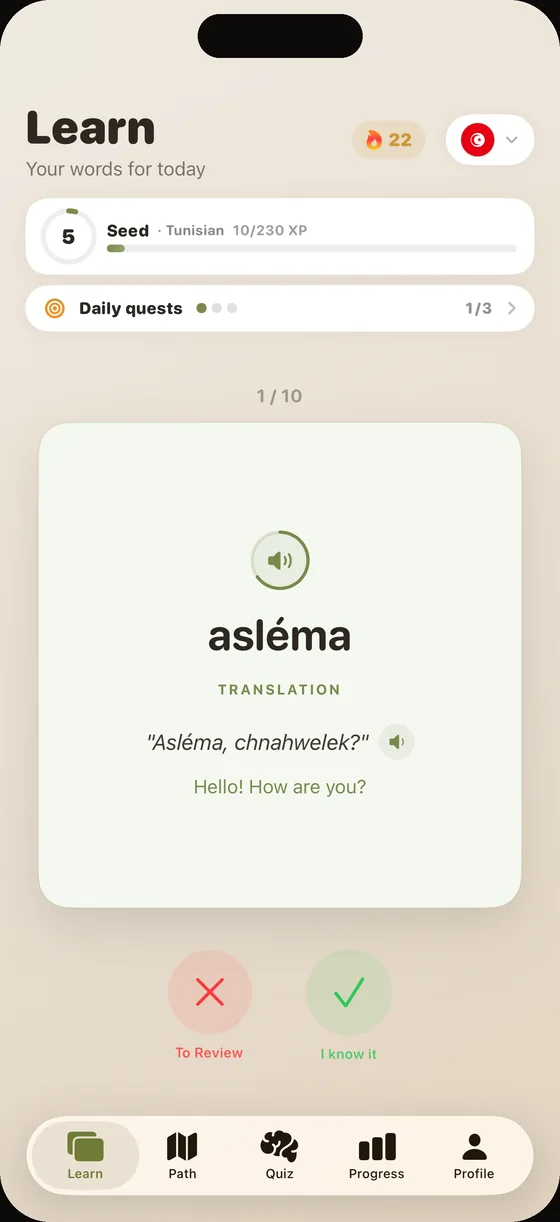
- Essential vocabulary: learn the words most used in everyday life.
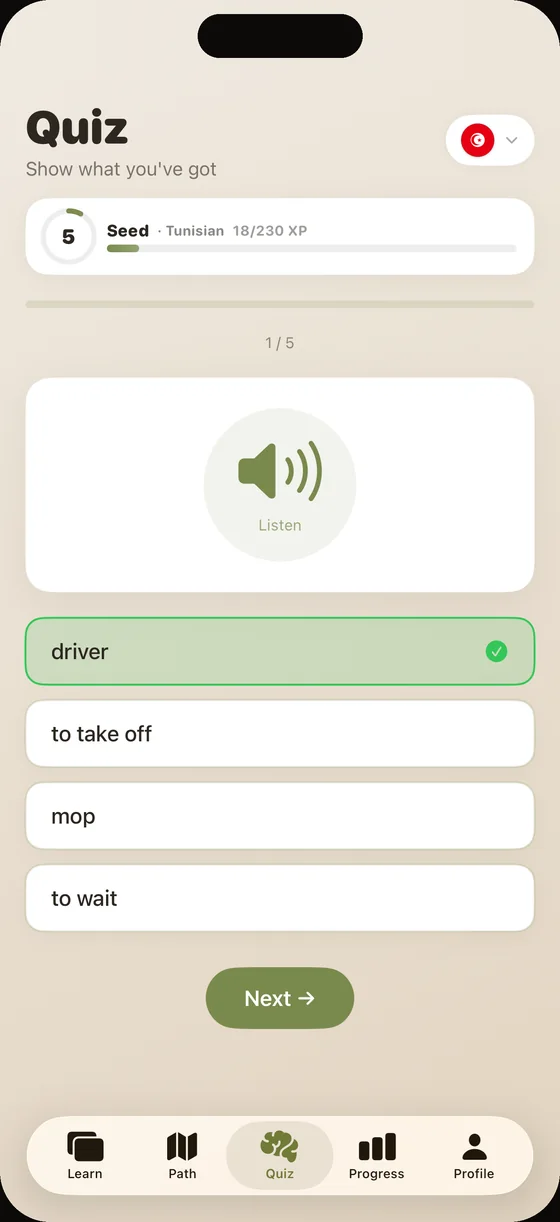
- Native audio: hear the exact pronunciation on every word.
- Interactive quizzes: test your knowledge and track your progress.
- Review mode: never lose what you've already learned.
The Science Behind Dialect
To be among the best educational resources, Dialect builds on cognitive neuroscience principles:
- Spaced Repetition System (SRS): our algorithm calculates the optimal time to review each word, right before you would forget it.
- Pure auditory immersion: native audio on every word, tuned for Tunisian derja.
- Granular learning: we break dialects into manageable units to prevent cognitive overload.
Tunisian in a few facts
- Language family: Maghrebi Arabic, with borrowings from Berber, Italian, Turkish, French and Spanish.
- Speakers: 11 to 12 million speakers.
- Main regions: Tunisia, with diaspora in France, Italy and Germany.
- Writing systems: Arabic script, plus Latin alphabet in digital communications (arabizi).
Tunisian Arabic shows the strongest Italian lexical presence among all Maghrebi varieties (cuisine, maritime, daily life). It has no official status but remains the language of daily life, popular media and artistic creation.
10 everyday Tunisian words
The vocabulary people actually use at home or at the market. The right-hand column gives the full sentence in Tunisian, exactly as it appears in the app.
| English | Tunisian | Example |
|---|---|---|
| water | ma | Ochrob ma. |
| to eat | yékel | Koul bel béhi. |
| to drink | Ochrob | Ochrob el ma. |
| home | dar | Ena fil dar. |
| mother | ommi | Ommi fi dar. |
| father | baba | Baba fi dar. |
| child | tfol | Etfol fel dar. |
| money | flous | Ma 3andouch flous. |
| market | sou9 | Nechri mel sou9. |
| tomorrow | ghodwa | Ghodwa nektbou. |
Tunisian is commonly written in the Latin alphabet, using digits for sounds Latin script lacks: 3 for ع, 7 for ح, 9 for ق. It also carries Italian and French loanwords that learners spot immediately.
How Dialect makes learning Tunisian easier
Learning a heritage language when you live in the diaspora has unique challenges: few structured resources, materials often aimed at linguists rather than daily learners, and a critical shortage of reliable audio recordings. Dialect was built to address these obstacles.
Specifically for Tunisian, the app provides:
- Progress by frequency of use: you first learn words and phrases you will actually hear.
- 100% native recordings: authentic accent from session one.
- Short sessions (5 cards a day): consistency beats intensity.
- Smart review: the spaced repetition algorithm presents each word right before you would forget it.
Hello, thank you and essential phrases in Tunisian
Looking to say hello in Tunisian, thank you or how are you? Here are the must-know greetings and polite forms:
| English | Tunisian |
|---|---|
| Hello | asléma |
| Thank you | 3aychek |
| Yes | ih |
| No | lé |
| Goodbye | bessléma |
| Sorry | séma7ni |
| Please | brabbi |
Frequently asked questions about learning Tunisian
How do you say hello in Tunisian?
In Tunisian Arabic (Derja), "hello" is "a7la" or "sba7 el5ir" (good morning). In an informal setting you can also say "aslama". Hear the exact pronunciation in the Dialect app.
How long does it take to learn the basics of Tunisian?
With Dialect, practicing 5 to 10 minutes a day, you can master essential Tunisian vocabulary in 4 to 6 weeks.
Is the Dialect app free?
Dialect is free to start: every day you get one session, one quiz and the Greetings lesson of the Path. Premium unlocks everything.
Does the Dialect app include audio for Tunisian?
Yes, every Tunisian word comes with native audio in the app to help you memorize the pronunciation.
Do I need to know any Arabic to start?
No. Dialect is designed for complete beginners.
Is Dialect available on Android?
Yes. The app is on Google Play. On desktop, Dialect runs directly in your browser through the web app (mydialect.io/app): same languages, same native audio, same account. The native app is available on iPhone and iPad from the App Store.
Learning Tunisian: the essentials
Neither Duolingo, nor Babbel, nor Memrise offers a Tunisian course. uTalk, which sells five varieties of Arabic, does not have Tunisian either. That leaves a handful of private tutors: the offering is thin. Dialect covers Tunisian with 997 words and phrases and 2,637 audio files in a native speaker's voice, Asma, grouped by theme and reviewed with spaced repetition. The app is free for one session per day per language, on iPhone, iPad, Android and the browser.
Discover other languages on Dialect
Dialect offers 19 heritage languages to reconnect with your roots:
Start for free, today
Free daily session. On iPhone via the App Store, on Android via Google Play, or straight in the browser on desktop.

 Scan with your phone · iPhone or Android
On a computer?
Open the web application