Best app to learn Breton in 2026
You're looking for an app to learn Breton — brezhoneg, the Celtic language of Brittany — and you quickly run into a frustrating fact: Duolingo, Babbel, Rosetta Stone, Busuu… no major platform offers it. For a language taught in immersion schools, supported by a public language office and broadcast by its own online TV channel, the mainstream digital options are surprisingly thin. This guide takes an honest tour of what actually exists — specialized apps, community evening classes, paper methods, online resources — and helps you choose based on your goal.
Quick answer: to speak everyday Breton — greetings, family, the words you heard at your grandparents' — Dialect is the most direct app: vocabulary and example sentences with clear audio on every word, spaced repetition and 5-minute sessions. Rated 4.7/5 on the App Store (August 2026). Community evening classes, paper methods such as Assimil-style courses, and online dictionaries are useful complements — details below.
Why Breton needs a dedicated app
Breton is a Celtic language, not a dialect of French
First things first, because the prejudice dies hard: Breton is not a dialect of French. It is a Celtic language of the Brittonic branch, a cousin of Welsh and Cornish, inherited from the Britons who crossed over from the island of Britain. Its grammar, core vocabulary and sounds are its own: "hello" is demat, "thank you" is trugarez, "how are you?" is penaos emañ kont?. None of that can be derived from French — or from any Romance language. Even the famous kenavo ("goodbye"), which all of Brittany knows, follows an entirely different linguistic logic. Learning Breton means learning a genuinely foreign language… that is at the same time a language of home.
A transmission broken in the 20th century
For centuries, Breton was passed down at home, from generation to generation. In the 20th century that chain broke: the language was banned at school and children were punished for speaking it — the humiliation of the "symbole", an object hung on any pupil caught speaking Breton, marked whole generations. Stigmatized and associated with shame, Breton often was not handed on to the children. The result today: Breton-speaking grandparents, parents who understand a few words, and grandchildren who received nothing — but who want to reconnect. If that sounds like you, our guide to learning your heritage language as an adult was written for you.
A real revival, but scattered resources
Over the past decades, Breton has enjoyed a revival many regional languages would envy: the Diwan schools teach through immersion, bilingual tracks exist in public and private education, the Ofis publik ar brezhoneg supports the language in public life, and media such as Brezhoweb broadcast in Breton. But for an adult who wants to start alone, between two metro rides, the options remain scattered: evening classes that require a fixed weekly slot, demanding paper methods, online dictionaries that assume you already know what to look up. What is often missing is the simplest foundation: ten minutes a day, on your phone, with sound.
The 4 criteria of a good Breton app
- Audio on every word — Breton has sounds and spellings you cannot guess from French or English: the c'h of c'hoar ("sister"), the nasal vowels written ñ as in evañ ("to drink"). Reading without hearing is only half the learning.
- Family-life vocabulary first — greetings, family, home, meals. You're learning Breton to use it with your own people and tie it to memories, not to sit a linguistics exam.
- A real memorization system — spaced repetition brings each word back at the optimal moment, just before you forget it. A vocabulary list read once evaporates; a word reviewed at the right time sticks.
- Short sessions and visible progress — 5 minutes a day kept up for 3 months beats an hour every Sunday abandoned in January. Daily streaks, milestones, badges: the app should make consistency easy.
Dialect in practice, with screenshots
Dialect was built for one precise use case: reconnecting with a family language the big platforms ignore. Breton is treated as a language in its own right, on equal footing with Kabyle, Wolof or Vietnamese — with clear audio on every word and every example sentence.
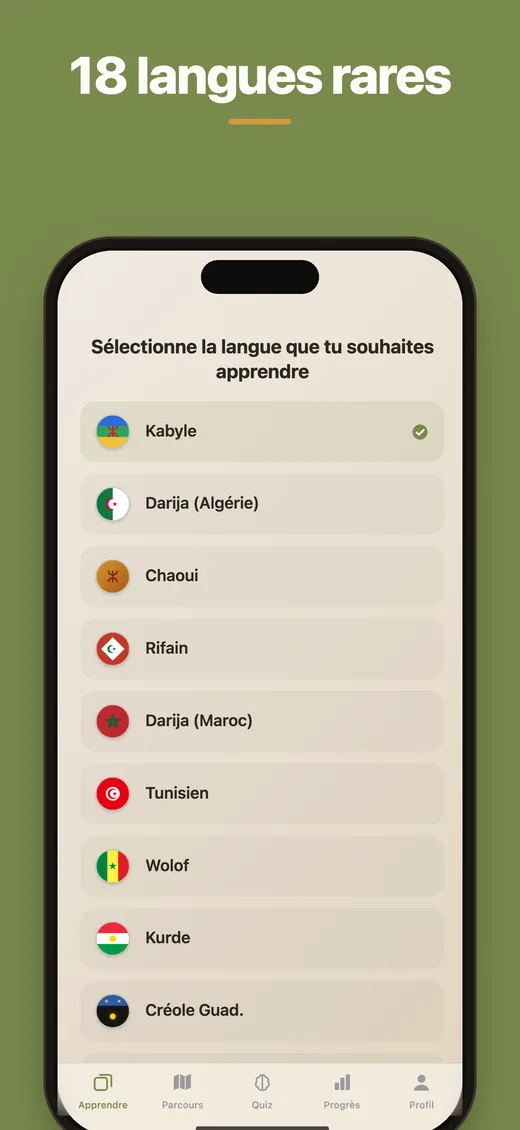
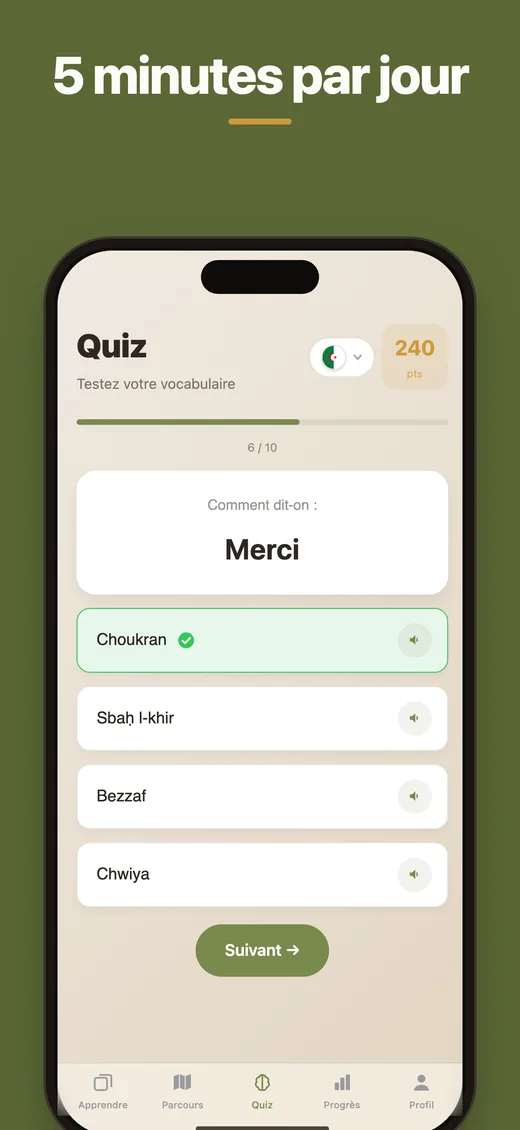
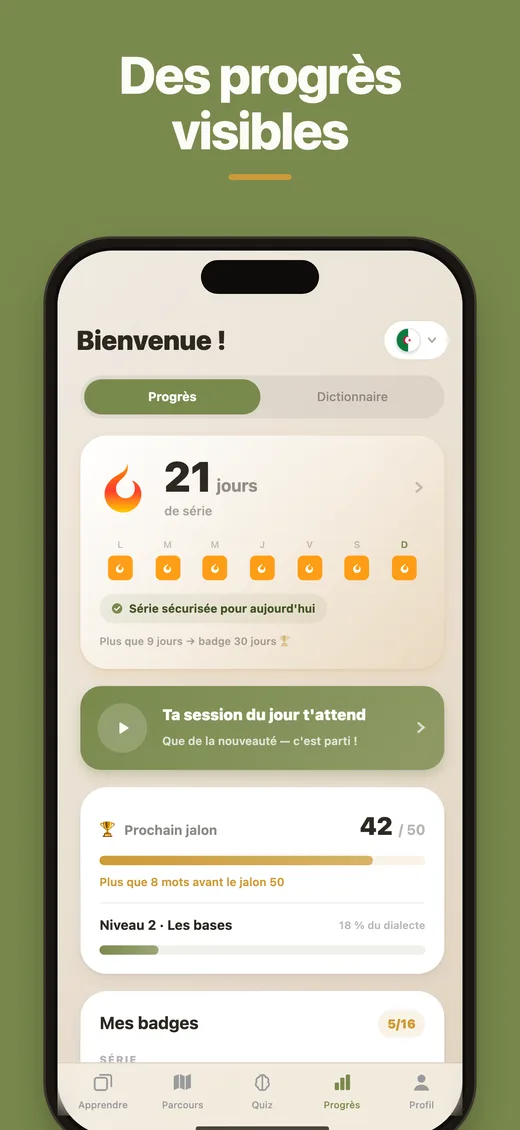
In concrete terms:
- Clear audio on every word: each word and example sentence plays in one tap — demat, trugarez, ma c'hoar a zo aet d'ar skol ("my sister went to school") — so you link spelling and sound from session one.
- Everyday vocabulary: family (tad-kozh, mamm-gozh), home (ti), meals (bara, dour), greetings — the words you will actually hear.
- Flashcards, quizzes and level-based tracks with spaced repetition: easy words space out, hard ones come back.
- 5-minute sessions, daily streaks, milestones (50, 100, 200 words…): built to fit a busy life.
- Free to start, on iPhone and on the web.
An honest comparison of the alternatives
The Breton ecosystem owes an enormous amount to the community organizations and institutions that have carried the language for decades — they deserve respect. Here is the real landscape in 2026:
| Solution | Strengths | Limits for learning Breton |
|---|---|---|
| Dialect | Clear audio on every word and sentence, everyday vocabulary, spaced repetition, 5-min sessions, designed for reconnecting with a family language, on iPhone, Android and web | No formal grammar course |
| Duolingo / Babbel / Rosetta Stone / Busuu | Proven methods, huge catalogs | Do not offer Breton. That gap is what this guide documents |
| Community evening classes and immersion courses | Real teachers, spoken practice in a group, local roots; Brittany's community network is dense, in Brittany and in Paris alike | Fixed schedules and a weekly rhythm: without daily practice between classes, most of it fades |
| Paper methods (Assimil-style courses and textbooks) | Structured progression, grammar explained, audio included depending on the edition | Require sustained solo discipline; no smart review and no memorization tracking |
| Online dictionaries and lexicons | Precious references for checking a word, mostly free | These are lookup tools, not methods: indispensable as backup, insufficient for learning to speak |
| Breton-language media (Brezhoweb, radio, songs) | Real, free immersion in living, contemporary Breton | No structure and no review system: perfect as a complement, insufficient on its own for a beginner |
Which solution for your profile?
- Your grandparents spoke Breton and you want to reconnect: Dialect, starting with greetings and family vocabulary — demat, trugarez, tad-kozh, mamm-gozh. These are the words you may already have heard, and the ones that bring back the most memories.
- You live in Brittany and want to reach conversation: combine a daily app with a community evening class or an immersion course. The app maintains vocabulary between sessions; the class gets you speaking in real situations.
- You're a Breton in Paris or abroad: the app is your daily foundation, far from in-person classes. Add Breton-language media (Brezhoweb, songs) to keep a living link with the language.
- You want to go deeper into grammar and writing: add a structured paper method or a course track, and keep an online dictionary at hand. The app remains useful for anchoring vocabulary over time.
The method that works, whatever the app
An app is not everything: method is what makes you progress. Here is the one we recommend — and that Dialect orchestrates automatically:
- 5 to 10 minutes a day, every day. Consistency beats intensity, with no known exception in the research.
- Audio from day one. Listen to each word several times, repeat out loud — the c'h of c'hoar can only be learned by pronouncing it, even alone in your kitchen.
- Trust the reviews. When a word comes back just as you thought you knew it, that is exactly when your memory needed it.
- Speak before you feel ready. From 50 words on, drop demat, trugarez and kenavo into a conversation with the Breton speakers around you. The smiles you'll get are worth all the badges.
Frequently asked questions
Can you learn Breton with Duolingo, Babbel or Rosetta Stone?
No. None of the major platforms — Duolingo, Babbel, Rosetta Stone, Busuu — offer Breton in 2026. For this Celtic language of Brittany, the available options come down to a few specialized apps, community evening classes, paper methods and online resources.
Is Breton a dialect of French?
No. Breton (brezhoneg) is a Celtic language of the Brittonic branch, a cousin of Welsh and Cornish. It descends neither from French nor from Latin: its grammar, core vocabulary and sounds are its own. Treating it as a mere patois is exactly the prejudice that nearly wiped it out in the 20th century.
How long until you can handle a simple exchange in Breton?
With 5 to 10 minutes a day, count on 2 to 3 months for your first phrases: greetings, family, everyday life. The decisive factor is not talent — it's consistency.
Where should I start if my grandparents spoke Breton?
With family-life vocabulary: greetings (demat, kenavo), politeness (trugarez, mar plij), family (tad-kozh, mamm-gozh). These are the words you may already have heard as a child, and the ones that bring back the most memories. A daily app is the foundation; an evening class or immersion course completes it when you want to move to conversation.
What kind of audio comes with Breton in Dialect?
Clear audio accompanies every Breton word and example sentence, so you can link spelling and sound from the first session. To hear living Breton and refine your accent, complement the app with Breton-language media such as Brezhoweb. To be plain about it: this is a high-quality synthetic voice, checked by ear, not human recordings.
5 minutes a day · Clear audio on every word · 4.7/5 on the App Store
On a computer? Try the web app →