Best app to learn Fula in 2026
You're looking for an app to learn Fula — called Pulaar, Pular or Fulfulde depending on the region — and you quickly run into the paradox: one of the most widespread languages of West Africa, spoken by more than 35 million people from Senegal to Cameroon, is missing from Duolingo, Babbel and Rosetta Stone. What does exist is scattered: community classes, YouTube channels, old textbooks, community-built apps in varying states of repair. This guide takes an honest tour of that landscape, and helps you choose based on your profile.
Quick answer: to speak everyday Fula — the language of family, of greetings, of calls back home — Dialect is the most direct app: Pulaar vocabulary organized into level-based tracks, flashcards and quizzes, spaced repetition and 5-minute sessions. Rated 4.7/5 on the App Store (August 2026), free to start. For in-depth grammar, or a variety other than Pulaar, other resources are useful complements — details below.
Why Fula needs a dedicated app
A major African language, absent from the major platforms
Fula is no obscure language: it is one of the most widely spoken languages of West Africa, present in some twenty countries, from the Senegal River to Lake Chad. The haalpulaaren — literally "those who speak Pulaar" — also form a large diaspora: in France above all, particularly around Paris, but also in the US and the UK, where the language lives on in families, community halls and hometown associations of the Senegal River valley. And yet no major learning platform offers it: not Duolingo, not Babbel, not Rosetta Stone. The result: those who want to learn it — children of the diaspora, spouses, the simply curious — end up improvising with a PDF from the 1960s, a YouTube channel and a vocabulary notebook. That is exactly the gap a dedicated app has to fill.
A continuum of varieties: Pulaar, Pular, Fulfulde
Fula forms a linguistic continuum that follows the history of Fula communities across the Sahel. It is called Pulaar in the Senegal River valley — the Futa Toro, between Senegal and Mauritania —, Pular in the Futa Jallon in Guinea, and Fulfulde further east, from Mali to Cameroon by way of Burkina Faso, Niger and Nigeria. The grammatical core is shared and mutual understanding is real, but pronunciation, certain turns of phrase and part of the vocabulary change from region to region. A good learning resource must therefore state clearly which variety it teaches — Dialect teaches Pulaar — rather than mixing words from across the continuum without saying so.
A noun-class language, with a script of its own
Fula belongs to the Atlantic language family, and its grammar looks like neither English nor French: no grammatical gender, but a system of noun classes — around twenty, depending on the variety — that governs agreement and even changes the first consonant of certain words. Disorienting on paper, natural in practice: you acquire it by memorizing words together with their surroundings, not by reciting tables. As for writing, Fula most often uses a Latin alphabet enriched with characters of its own — ɓ, ɗ, ŋ, ƴ — which mark sounds English doesn't have; there is also Adlam, an alphabet created in Guinea in the 1980s specifically for Fula. A generic, off-the-shelf course copied from another language misses all of this; you need content built for Fula, word by word.
The 4 criteria of a good Fula app
- A clearly identified variety — Pulaar, Pular or Fulfulde. If a resource just says "Fulani" without specifying, be wary: you risk learning a mix nobody actually speaks. Choose the variety of your family or the region closest to your heart.
- Everyday vocabulary first — greetings, family, polite phrases, food. Jam (peace, at the heart of every greeting) and a jaaraama (thank you) should come in the first lessons, not "the airport" or "the hotel booking": you're learning Fula to talk to your own people.
- A real memorization system — spaced repetition brings each word back at the optimal moment, just before you forget it. Without it, you retain barely 20% of what you study — and Fula's noun classes are exactly the kind of thing that needs regular returns.
- Short sessions and visible progress — 5 minutes a day kept up for 3 months beats an hour every Sunday abandoned in January. The app should make consistency easy: daily streaks, milestones, levels, badges.
A word about your ear: whatever resource you choose, nothing replaces listening to native speakers — a call to family, Pulaar-language radio (the national-language newsrooms of Senegal and Mauritania stream online), the Haalpulaar creators on YouTube and TikTok. Make it a systematic complement to your reviews: the vocabulary learned in the app comes alive when you recognize it in a real conversation.
Dialect in practice, with screenshots
Dialect was built precisely for this use case: diaspora members and spouses who want to speak the family's language (again). Fula is treated as a language in its own right, with its variety stated up front — the Pulaar of the Senegal River valley — and its own script, characters ɓ, ɗ, ŋ and ƴ included.
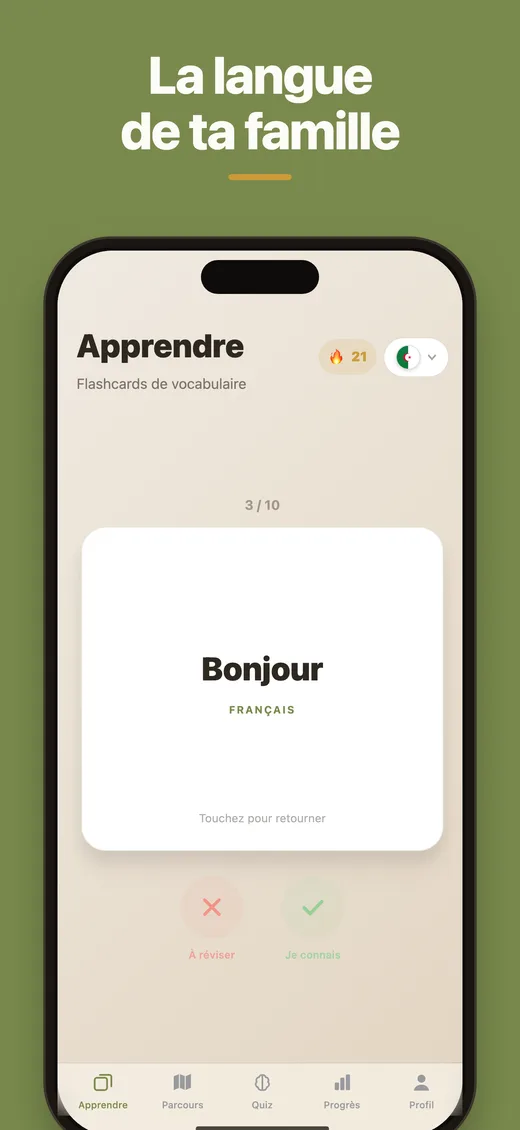
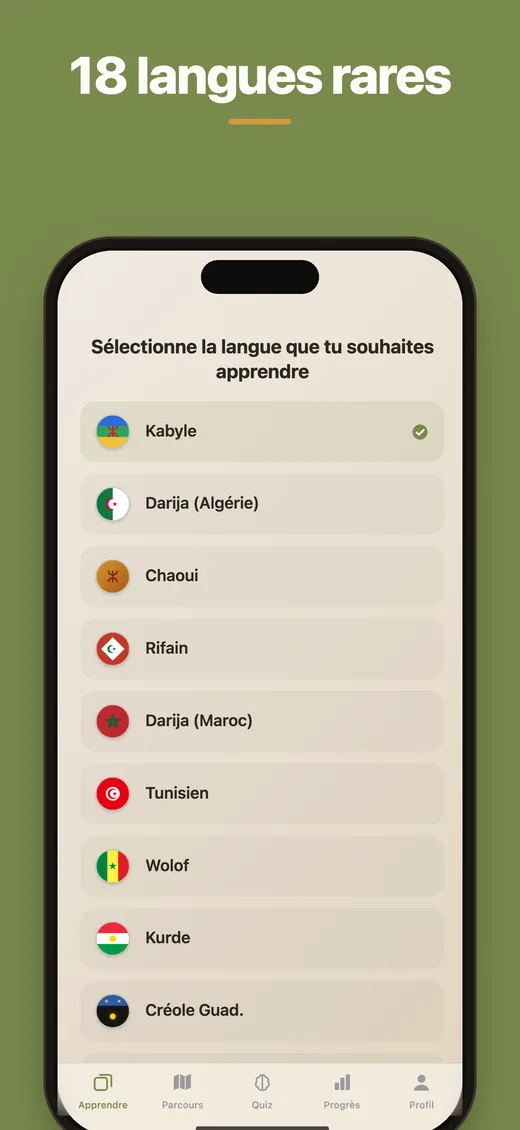
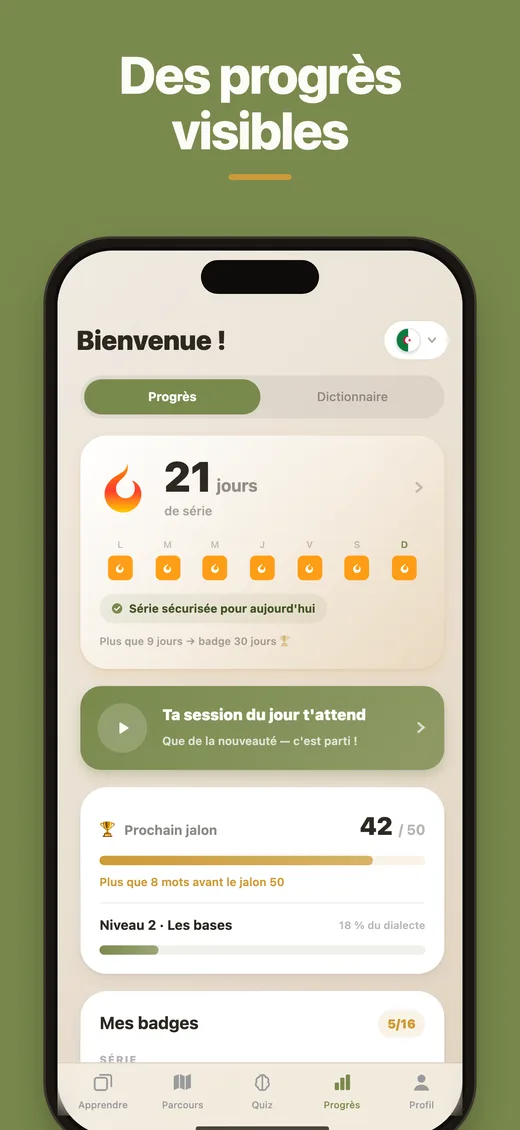
In concrete terms:
- A level-based Pulaar track: greetings, family, polite phrases, daily life — vocabulary in the order you'll need it on the phone with your own people.
- Flashcards and quizzes: each word works in both directions (into Pulaar and back), with example sentences written in correct Fula spelling.
- Spaced repetition: easy words space out, hard ones come back. Nothing to plan — the app decides what to review and when.
- 5-minute sessions, daily streaks, milestones (50, 100, 200 words…): built to fit a busy life.
- Free to start, on iPhone and on the web.
An honest comparison of the alternatives
No solution is perfect for everyone. Here is the real landscape in 2026:
| Solution | Strengths | Limits for Fula |
|---|---|---|
| Dialect | Level-based Pulaar track, flashcards and quizzes, spaced repetition, 5-min sessions, progress tracking, designed for the diaspora, on iPhone, Android and web | No formal grammar course; teaches Pulaar (speakers of eastern Fulfulde will need to adapt) |
| Duolingo / Babbel / Rosetta Stone | Proven methods, huge catalogs | Do not offer Fula in any form — not Pulaar, not Pular, not Fulfulde |
| Community apps (Pulaar Courseware, Fula M(A)L…) | Built by enthusiasts, often free, vocabulary lists and dialogues | Coverage and quality vary, little or no scheduled review, uncertain maintenance from one app to the next |
| Historic free courses (FSI, Peace Corps — on Live Lingua) | Free, very thorough on grammar and dialogues | Designed decades ago for field workers: austere PDFs, no interactivity, no memorization tracking |
| YouTube, TikTok and community groups | Free, real immersion, active Haalpulaar creators, exchanges with speakers | No structure and no review system: perfect as a complement, insufficient on its own for durable memorization |
| Multi-language African apps | Several African languages in one app, short lessons | Very broad catalog: check how many words and sentences exist for your language, and what stays available without a subscription |
Which solution for your profile?
- You're from the diaspora and want to talk with family: Dialect, starting with greetings and family vocabulary. Add calls back home — the best practice lab there is, and the finest encouragement.
- Your partner or in-laws are Fula: same path. A well-placed a jaaraama at the right moment is worth any long speech — aim for your first 50 words before the next family gathering.
- You're preparing a stay in the Futa Toro, the Futa Jallon or the Sahel: Dialect for the everyday foundation, plus a structured course (community-run or online) for grammar if you're aiming for elaborate conversations. Check the local variety of your destination.
- You're curious about African languages, or a linguistics student: the historic FSI and Peace Corps courses remain gold mines for grammar and the noun-class system; Dialect will give you the living vocabulary and the consistency in parallel.
- You just want a few polite phrases: our free guides (how to say hello in 15 languages) and a week of Dialect are enough to greet people with dignity.
The method that works, whatever the app
An app is not everything: method is what makes you progress. Here is the one we recommend — and that Dialect orchestrates automatically:
- 5 to 10 minutes a day, every day. Consistency beats intensity, with no known exception in the research.
- Expose your ear in parallel. Pulaar radio, videos by Haalpulaar creators, and above all the conversations around you: listen, spot the words you've learned, repeat out loud.
- Trust the reviews. When a word comes back just as you thought you knew it, that is exactly when your memory needed it.
- Speak before you feel ready. From 50 words on, drop jam tan ("peace only", the answer to a greeting) and a jaaraama into a family call. The smiles you'll get are worth all the badges.
Frequently asked questions
Can you learn Fula with Duolingo?
No. Duolingo does not offer Fula in any of its forms (Pulaar, Pular or Fulfulde), and neither do Babbel or Rosetta Stone. Despite its tens of millions of speakers, Fula is missing from the catalogs of every major language-learning platform in 2026 — like most major African languages.
Pulaar, Pular, Fulfulde: what's the difference?
They are three regional names for one language, Fula, which forms a continuum: Pulaar in the Senegal River valley (Senegal, Mauritania), Pular in the Futa Jallon in Guinea, and Fulfulde from Mali to Cameroon by way of Niger, Burkina Faso and Nigeria. The underlying grammar is shared and speakers largely understand each other; pronunciation and part of the vocabulary vary. Even thank you travels well: a jaaraama (to one person) and on jaaraama (to several, or out of respect) are understood in the Pular of Guinea as well as the Pulaar of the Futa Toro. Dialect teaches Pulaar.
Which variety of Fula does Dialect teach?
Pulaar, the variety of the Senegal River valley (Senegal and Mauritania) — the one spoken by the majority of the Fula diaspora settled in France, and by many Pulaar-speaking communities abroad. Thanks to the language's shared core, a Pulaar learner is understood well beyond the Futa Toro, allowing for a period of adjustment to the accent and a few local words.
Do you need to know the characters ɓ, ɗ, ŋ and ƴ to get started?
No, not to get started. Fula is most often written in a Latin alphabet enriched with a few letters (ɓ, ɗ, ŋ, ƴ) that mark sounds specific to the language. You pick them up naturally as you meet the words — count a few days, not weeks. The Adlam alphabet, created in Guinea to write Fula, can come later if the subject interests you.
How long does it take to hold a simple conversation in Fula?
With regular practice of 5 to 10 minutes a day, most learners can handle simple exchanges (greetings, family, polite phrases) within 2 to 3 months. Consistency matters more than session length: that is the principle of spaced repetition.
Is the Fula audio in Dialect recorded by native speakers?
No. For Fula, Dialect uses a high-quality synthetic voice: every word and every sentence has clear audio. Fula spans a vast area from Senegal to Cameroon, with pronunciation varying widely between regions — no single recording would suit everyone. We say so rather than claim a native voice that would in any case be regional.
5 minutes a day · Free to start · 4.7/5 on the App Store
On a computer? Try the web app →