Best app to learn Malagasy in 2026
You're looking for an app to learn Malagasy — the national language of Madagascar — and you quickly run into a frustrating fact: Duolingo, Babbel, Rosetta Stone… no major platform offers it. For a language spoken by around 25 million people, with a large diaspora in France, Réunion and beyond, the digital options are surprisingly thin. This guide takes an honest tour of what actually exists — specialized apps, printed textbooks, online dictionaries, YouTube channels — and helps you choose based on your goal.
Quick answer: to speak everyday Malagasy — the language of family meals, calls to Antananarivo, trips back home — Dialect is the most direct app: everyday vocabulary and sentences with clear audio on every word, spaced repetition and 5-minute sessions. Rated 4.7/5 on the App Store (August 2026). Printed textbooks, online dictionaries and YouTube channels are useful complements — details below.
Why Malagasy needs a dedicated approach
An Austronesian language, not an African one
First things first, because the surprise is universal: Malagasy is not an African language. It is an Austronesian language of the Malayo-Polynesian branch — the same broad family as Malay and Indonesian — related to the languages of southern Borneo. The ancestors of the Malagasy crossed the Indian Ocean more than a thousand years ago, and their language traveled with them: one of the greatest maritime adventures in human history, written into every sentence spoken in Madagascar today. The practical consequence: neither Swahili, nor French, nor any language of the neighboring continent will give you the keys to Malagasy. Its grammar — verb-first sentences, an original voice system — and its core vocabulary are its own: "hello" is manao ahoana, "thank you" is misaotra, "goodbye" is veloma.
Merina, the Latin alphabet, and a pronunciation to tame
Official Malagasy — the language of schools, media and administration — is based on Merina, the variety of the highlands around Antananarivo, understood across Madagascar. Good news for learners: Malagasy has been written in the Latin alphabet since the early 19th century, with no special characters. The difficulty lies elsewhere: pronunciation cannot be guessed from spelling — the letter "o" is pronounced "oo", and long written words are often pronounced shorter than they look. Hence the crucial importance of audio: your ear needs to hear misaotra and rahampitso, not just read them.
A language of family transmission in the diaspora
France is home to one of the largest Malagasy communities outside Madagascar, and many families share the same experience: the children understand Neny's and Dada's Malagasy without daring to speak it, everyone sings at family celebrations without catching all the words, and you want the next generation to hear the language of Dadabe and Bebe. Relearning Malagasy is less about "learning a foreign language" than about reconnecting a thread — before the next trip back home, a wedding in Antananarivo, a family reunion at the village. That changes the method entirely: you need speech first, family-life vocabulary, and sessions short enough to fit a busy life. That is exactly the subject of our guide to learning your heritage language as an adult.
The 4 criteria of a good Malagasy resource
- Audio on every word — Malagasy pronunciation cannot be derived from spelling. A silent vocabulary list will teach you to read, not to speak or to understand your family. Check that clear audio accompanies every word and sentence.
- Family-life vocabulary first — greetings, family, meals, emotions. You're learning Malagasy to talk to your own people, not to recite abstract lists.
- A real memorization system — spaced repetition brings each word back at the optimal moment, just before you forget it. A vocabulary list read once evaporates; a word reviewed at the right time sticks.
- Short sessions and visible progress — 5 minutes a day kept up for 3 months beats an hour every Sunday abandoned in January. Daily streaks, milestones, badges: the resource should make consistency easy.
Dialect in practice, with screenshots
Dialect was built precisely for this use case: diaspora members who want to speak their family's language again. Malagasy is treated as a language in its own right, on equal footing with the app's other rare languages, with clear audio on every word and example sentence.
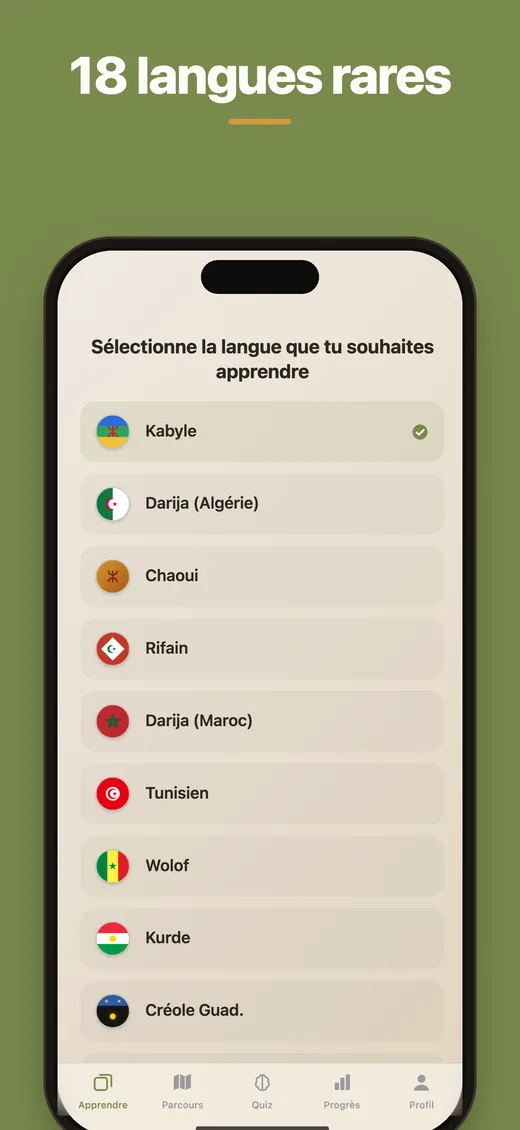
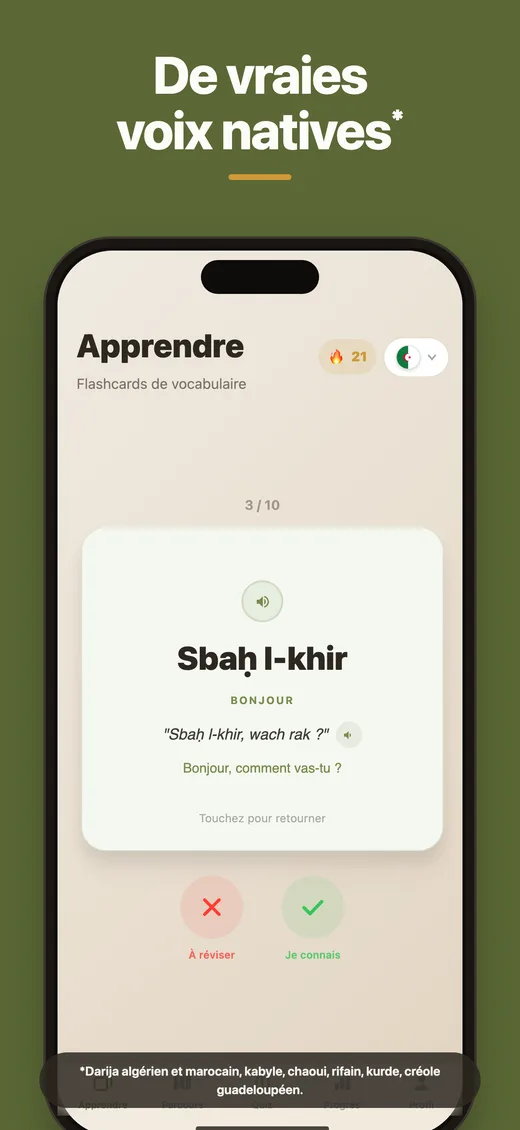
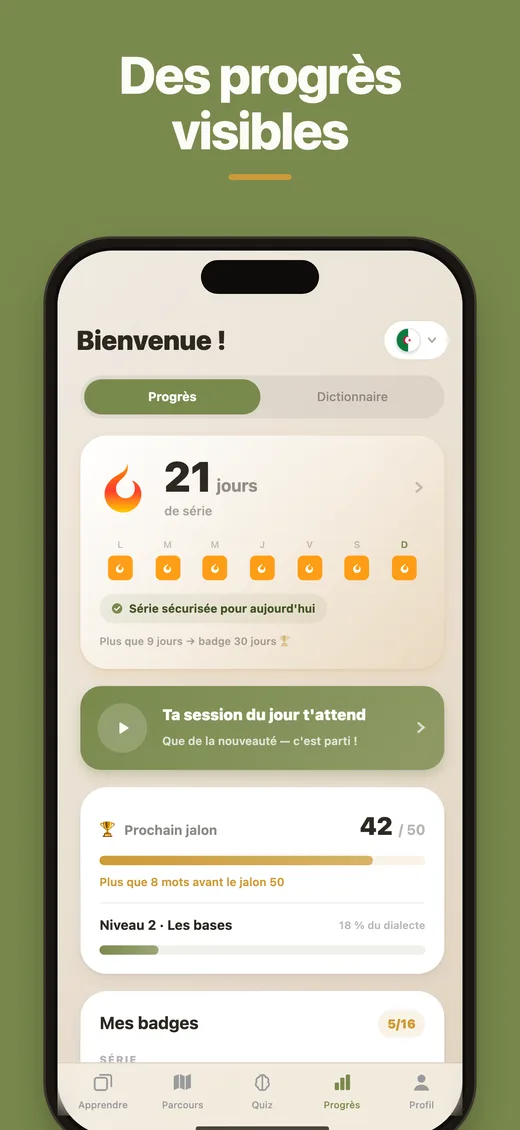
In concrete terms:
- Clear audio on every word: every word and every example sentence can be played and replayed — misaotra, veloma, azafady enter your ear before they leave your mouth.
- Family and everyday vocabulary first: dadabe (grandfather), bebe (grandmother), trano (house), rano (water) — the words you will actually hear at the table.
- Flashcards, quizzes and level-based tracks with spaced repetition: easy words space out, hard ones come back.
- 5-minute sessions, daily streaks, milestones (50, 100, 200 words…): built to fit a busy life.
- Free to start, on iPhone and on the web.
An honest comparison of the alternatives
For Malagasy, the digital ecosystem is even thinner than for other heritage languages. Here is the real landscape in 2026, by broad category:
| Solution | Strengths | Limits for learning Malagasy |
|---|---|---|
| Dialect | Clear audio on every word and sentence, everyday and family vocabulary, spaced repetition, 5-min sessions, designed for the diaspora, on iPhone, Android and web | No formal grammar course |
| Duolingo / Babbel / Rosetta Stone | Proven methods, huge catalogs | Do not offer Malagasy. That gap is what this guide documents |
| Printed textbooks and phrasebooks | Structured grammar explanations, progressions designed by educators, useful for understanding how the language works | Little or no audio, no review mechanism; you read Malagasy without hearing it — and its pronunciation cannot be guessed |
| Online Malagasy dictionaries | Precious references for checking a word, often free | These are lookup tools, not methods: indispensable as backup, insufficient for learning to speak |
| YouTube, music, Malagasy radio | Free, real immersion, a living musical heritage and channels run by passionate speakers | No structure and no review system: perfect as a complement, insufficient on its own for durable memorization |
| Malagasy cultural associations and classes | Human contact, live correction, community anchoring — particularly around Paris and in Réunion | Fixed schedules, limited availability depending on the city; combine with daily practice between classes |
Which solution for your profile?
- You're from the diaspora and want to talk with family: Dialect, starting with greetings and family vocabulary. Add calls to Madagascar — the best and most moving practice lab there is.
- You understand Malagasy but don't dare speak it: your ear is already trained; what you lack is active vocabulary. Dialect's quizzes and spaced repetition are built to turn passive understanding into spoken sentences.
- You're preparing a trip or a return home: focus on greetings and polite phrases — manao ahoana, misaotra, azafady open every door in Madagascar. A few weeks of daily practice are enough for a first foundation.
- You want to go deeper into grammar and writing: combine a daily speaking app with a textbook or structured course, and keep a reference dictionary at hand.
The method that works, whatever the resource
An app is not everything: method is what makes you progress. Here is the one we recommend — and that Dialect orchestrates automatically:
- 5 to 10 minutes a day, every day. Consistency beats intensity, with no known exception in the research.
- Audio from day one. Listen to each word several times, repeat out loud — Malagasy pronunciation is learned with the ear, not the eyes.
- Trust the reviews. When a word comes back just as you thought you knew it, that is exactly when your memory needed it.
- Speak before you feel ready. From 50 words on, drop manao ahoana, misaotra and veloma into a family call. The smiles you'll get are worth all the badges.
Frequently asked questions
Can you learn Malagasy with Duolingo, Babbel or Rosetta Stone?
No. None of the major platforms — Duolingo, Babbel, Rosetta Stone — offer Malagasy in 2026. For this language spoken by around 25 million people, the available options come down to a few specialized apps, printed textbooks, online dictionaries and community resources.
Is Malagasy an African language?
No. Malagasy is an Austronesian language of the Malayo-Polynesian branch: it is related to the languages of Borneo, not to the languages of the neighboring African continent. It is the legacy of the seafarers who crossed the Indian Ocean more than a thousand years ago. A Swahili course — or any other African language course — will not help you speak Malagasy.
Which Malagasy do apps teach?
Official Malagasy, based on Merina, the variety of the highlands around Antananarivo. It is the language of schools, media and administration, understood across Madagascar. Regional varieties (Betsimisaraka, Sakalava…) are close enough that it makes the best starting point.
How long until you can hold a simple conversation in Malagasy?
With 5 to 10 minutes a day, count on 2 to 3 months for simple exchanges: greetings, family news, meals. The decisive factor is not talent — it's consistency.
Is there audio for Malagasy in Dialect?
Yes. Every Malagasy word and example sentence comes with clear audio that you can play and replay as many times as you need — and it's the #1 criterion we advise you to check everywhere else, because Malagasy pronunciation cannot be derived from spelling. To be plain about it: this is a high-quality synthetic voice, checked by ear, not human recordings.
5 minutes a day · Audio on every word · 4.7/5 on the App Store
On a computer? Try the web app →