Best app to learn Tamil in 2026
You're looking for an app to learn Tamil — the language of your parents, your grandparents, or your in-laws — and you quickly run into a double problem. First, the big platforms like Duolingo and Babbel simply don't offer it. Second, the resources that do exist (apps, courses, textbooks) mostly teach literary Tamil or the script — when what the diaspora wants first is to speak. This guide takes an honest tour of what actually exists in 2026, and helps you choose based on your profile.
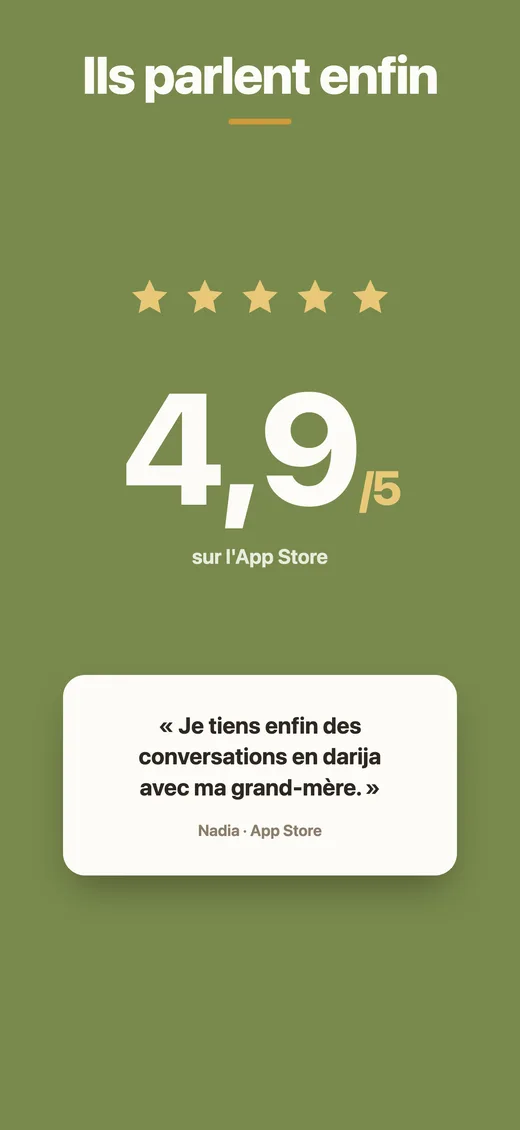
Quick answer: to speak everyday Tamil — the Tamil of family meals, of calls to amma, of ordinary conversations — Dialect is the most direct app: spoken Tamil (not the literary register), a Latin transcription so you can start without the Tamil script, clear audio on every word and every sentence, spaced repetition and 5-minute sessions. Rated 4.7/5 on the App Store (August 2026), free to start. For the Tamil script or literature, a community school or a tutor are useful complements — details below.
Why Tamil needs a dedicated app
A language two thousand years old… and two languages in one
Tamil is a Dravidian language, spoken by roughly 80 million people in South India (Tamil Nadu), Sri Lanka, Singapore, Malaysia and a vast diaspora. It is also one of the world's oldest living languages: its literature, going back to the Sangam poems, spans more than two thousand years. That historical depth has a downside for learners: a very marked diglossia. Literary Tamil (centamil) — the Tamil of school, official speeches and the written press — and spoken Tamil (kotuntamil) — the Tamil of conversations, families and films — differ deeply, in grammar as in pronunciation. Many courses and textbooks teach the former; yet understanding your aunt on the phone requires the latter. A good app has to be upfront about which register it teaches.
The Tamil script: a barrier to entry (that you can work around)
Tamil has its own script, beautiful and perfectly logical: 12 vowels, 18 consonants, and more than 200 syllabic combinations to memorize before you can read your first word. If you want to read the poets or write to your family, that effort is worth it. But if you want to speak first, it pushes your first conversation back by several months. The diaspora itself often writes Tamil in Latin letters in everyday messages. Dialect's choice — a Latin transcription you can read immediately (vanakkam, nandri) — removes that barrier: you speak from the first week, and the script can come later, by another route.
Pronunciation can only be learned by ear
Tamil distinguishes sounds that English does not: retroflex consonants (the tip of the tongue curls back toward the palate, as in the ḻ of tamiḻ, the very name of the language), a strict opposition between short and long vowels, several different "r" and "l" sounds. No transcription, Latin or Tamil, captures these nuances on its own: you have to listen to each word, several times, and repeat. That makes it a knockout criterion: a Tamil app without systematic audio — or with audio on only part of its content — cannot teach you to speak.
The 4 criteria of a good Tamil app
- Spoken Tamil, not just the literary register — check that the app teaches eppadi irukkinga? (how are you?, everyday register) and not only the written forms. Spoken Tamil is what connects you to your family.
- Audio on every word and every sentence — not just on vocabulary lists. Retroflexes and long vowels can only be acquired by ear; your pronunciation calibrates on what you listen to.
- A real memorization system — spaced repetition brings each word back at the optimal moment before you forget it. Without it, you retain a fraction of what you study.
- Short sessions and visible progress — 5 minutes a day kept up for 3 months beats an hour every Sunday abandoned in January. The app should make consistency easy (streaks, milestones, reminders).
Dialect in practice, with screenshots
Dialect was built precisely for this use case: diaspora members and spouses who want to speak the family's language (again). Tamil is taught in its spoken register, in Latin transcription, with the vocabulary of real situations: greeting (vanakkam), thanking (nandri, or romba nandri for a big thank-you), asking how someone is doing (eppadi irukkinga?), answering (nalla irukken, I'm fine), naming your own people (amma, appa, akka, anna).
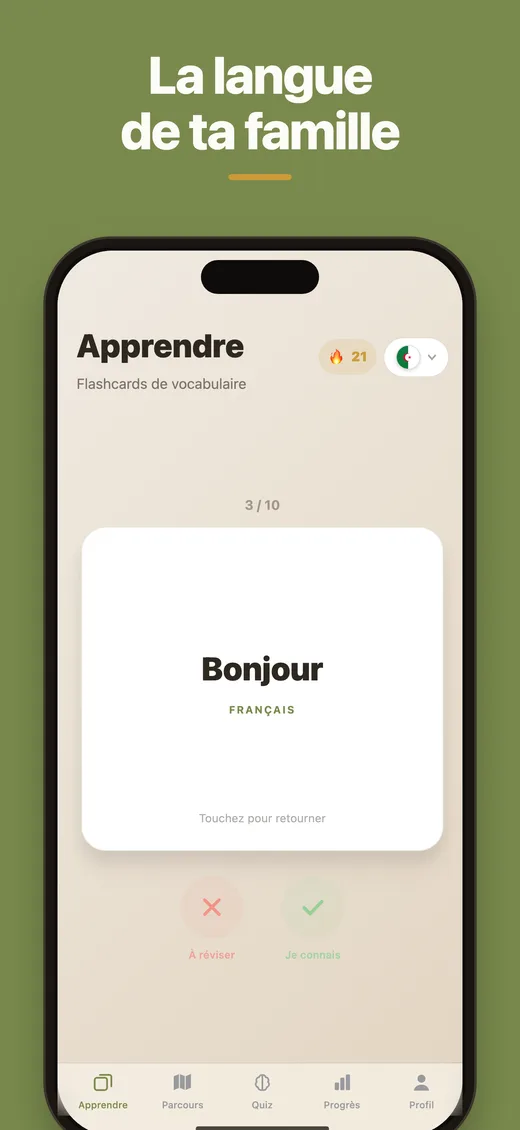
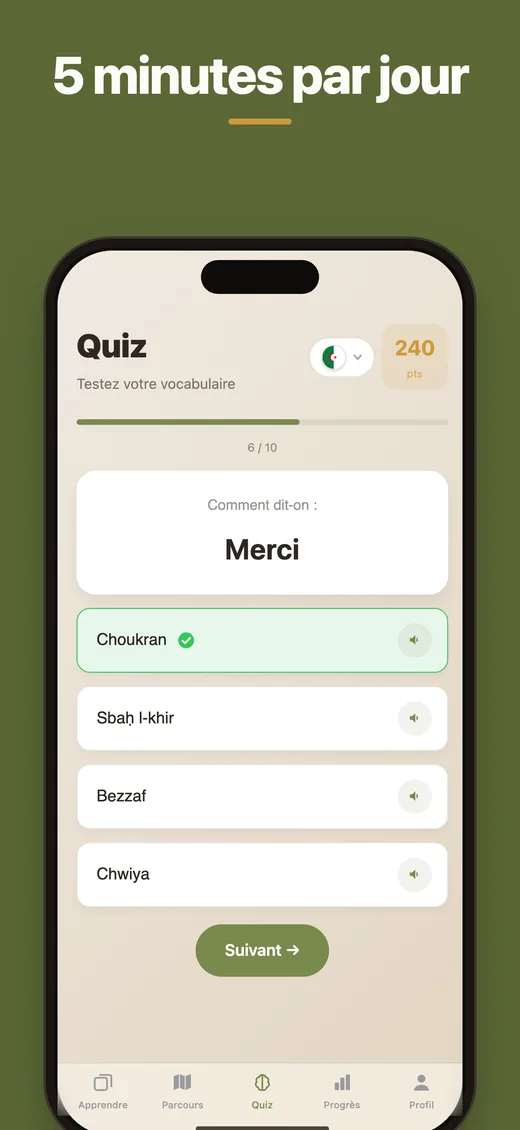
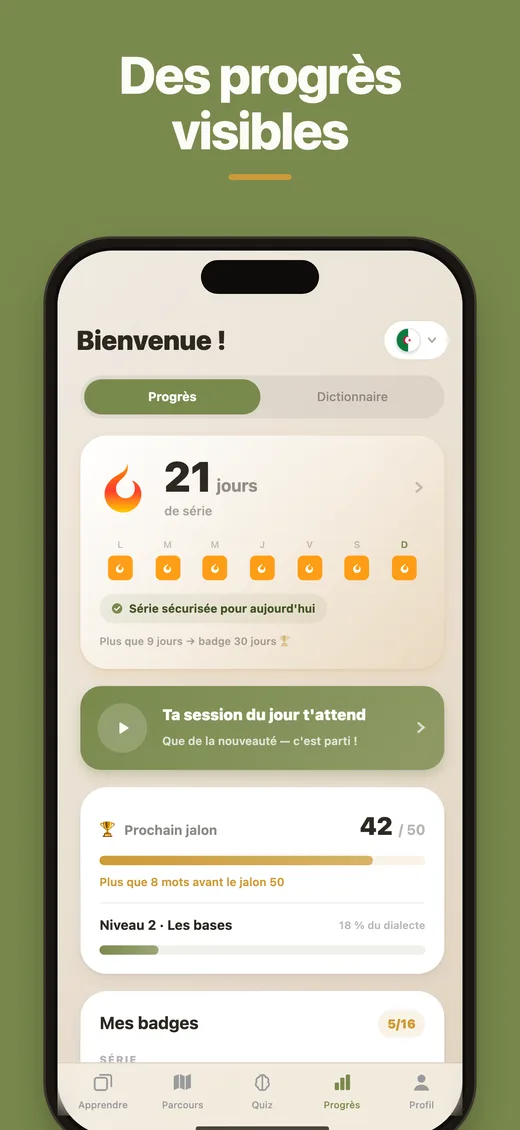
In concrete terms:
- Everyday spoken Tamil: the everyday register, the one used in family conversations — not the literary Tamil of textbooks. You learn what you will actually hear.
- Latin transcription: vanakkam, nandri, saptingala? (have you eaten? — the true Tamil welcome question). No need to master the Tamil script before you start speaking.
- Clear audio on every word and every sentence: you listen, listen again and repeat as many times as needed to lock in retroflexes and long vowels.
- Flashcards, quizzes and level-based tracks with spaced repetition: easy words space out, hard ones come back.
- 5-minute sessions, daily streaks, milestones (50, 100, 200 words…): built to fit a busy life.
- Free to start, on iPhone and on the web.
An honest comparison of the alternatives
Unlike some rare languages, Tamil is not a desert: serious resources exist. But most are general courses or phrasebooks, and many favor the written language. Here is the real landscape in 2026:
| Solution | Strengths | Limits if your goal is to speak |
|---|---|---|
| Dialect | Everyday spoken Tamil, Latin transcription, clear audio on every word and every sentence, spaced repetition, 5-min sessions, designed for the diaspora, on iPhone, Android and web | Does not teach the Tamil script or the literary register; the Tamil audio is a high-quality synthetic voice, not a human recording |
| Duolingo / Babbel / Rosetta Stone | Proven methods, huge catalogs | Do not offer Tamil. No course at all, in any language |
| General language apps (Ling, Simply Learn Tamil, 50 Languages…) | Actually offer Tamil: gamified lessons (Ling), phrase guides (Simply Learn), free audio lessons (50 Languages) | Register and audio quality vary from app to app; mostly generic courses or travel phrasebooks, rarely designed around the diaspora's family-first use case |
| Community Tamil schools and private tutors | Real human interaction, pronunciation correction; diaspora schools also pass on the script and the culture | Fixed schedules, cost, and teaching often centered on written and literary Tamil — an ideal complement, but rarely enough on its own for everyday speech |
| YouTube / films / songs | Free, real immersion in spoken Tamil, an immensely rich Tamil cinema | No structure and no review system: perfect as a complement, insufficient on its own for durable memorization |
Which solution for your profile?
- You're from the Tamil diaspora and want to talk with family: Dialect, starting with greetings and family vocabulary. In France, the Tamil community — largely of Sri Lankan origin, arrived since the 1970s and 80s — is one of the most vibrant in Europe: opportunities to practice abound, from family meals to the shops of La Chapelle in Paris, and the same is true across the diaspora's other hubs.
- Your spouse or in-laws are Tamil: Dialect for the spoken foundation (greeting, thanking, complimenting the cooking — romba nandri!), and let the family do the rest: a well-placed vanakkam opens every door.
- You also want to read and write Tamil: start speaking with Dialect, then learn the script in parallel, ideally at a community Tamil school or with a tutor. The two paths reinforce each other instead of competing.
- You're preparing a trip to Tamil Nadu or Sri Lanka: a few weeks of Dialect are enough for the basics of politeness and simple exchanges. Our free guides (how to say hello in 15 languages) give you a taste.
The method that works, whatever the app
An app is not everything: method is what makes you progress. Here is the one we recommend — and that Dialect orchestrates automatically:
- 5 to 10 minutes a day, every day. Consistency beats intensity, with no known exception in the research.
- Audio from day one. Listen to each word several times, repeat out loud — even alone in your kitchen. Retroflexes come from imitating, not from reading.
- Trust the reviews. When a word comes back just as you thought you knew it, that is exactly when your memory needed it.
- Speak before you feel ready. From 50 words on, drop vanakkam and eppadi irukkinga? into a family call. The smiles you'll get are worth all the badges.
Frequently asked questions
Can you learn Tamil with Duolingo?
No. Duolingo does not offer a Tamil course, and neither do Babbel or Rosetta Stone. Apps that do teach Tamil exist, but almost all of them are general courses or phrasebooks. For everyday spoken Tamil built around family life, Dialect is one of the few options.
Do you need to learn the Tamil script to speak Tamil?
No, not to get started. The Tamil script (12 vowels, 18 consonants, over 200 combinations) is a beautiful thing to learn, but it delays speaking by several months. Dialect uses a Latin transcription (vanakkam, nandri) so you can speak from the very first week; the script can come later, for instance through a community Tamil school.
Are Indian Tamil and Sri Lankan Tamil the same language?
Yes, it is the same language, with differences in accent and vocabulary between Tamil Nadu and Sri Lanka (the Jaffna variety is known to be more conservative). Everyday spoken Tamil — greetings, family, food — remains largely shared: what you learn will be understood on both sides of the Palk Strait.
How long until you can hold a simple conversation in Tamil?
With 5 to 10 minutes a day, count on 2 to 3 months for simple exchanges: greetings, family news, meals. The decisive factor is not talent — it's consistency.
What is the best app to learn Tamil?
It depends on your goal. For everyday spoken Tamil — Latin transcription, clear audio on every word and every sentence, spaced repetition, 5-minute sessions — Dialect is the most direct option. For the script or literary Tamil, a community school or a private tutor are useful complements.
Is the Tamil audio in Dialect recorded by native speakers?
No. For Tamil, Dialect uses a high-quality synthetic voice, chosen for its spoken rather than literary register: every word and every sentence has clear audio. Tamil separates written and spoken language sharply; the app teaches the spoken one — the language actually heard at home.
5 minutes a day · Free to start · 4.7/5 on the App Store
On a computer? Try the web app →