Best app to learn Chaoui in 2026
Type "learn Chaoui" into an app store and you'll reach a quick conclusion: there is almost nothing. Chaoui — Tachawit, the Amazigh language of the Aurès mountains, spoken by several million people between Batna, Khenchela and Oum El Bouaghi in eastern Algeria — is one of the great absentees of the digital world. No major platform teaches it, and the dedicated apps can be counted on one hand. This guide takes an honest look at what actually exists in 2026, and explains what an app has to offer for learning Chaoui at a distance to finally be possible.
Quick answer: the options for learning Chaoui are close to nonexistent — neither Duolingo, nor Babbel, nor any major platform offers it. Dialect is one of the only apps in the world to teach Chaoui with 100% native audio: every word and every sentence is recorded by real Chaoui speakers, with no text-to-speech. Spaced repetition, 5-minute sessions, free to start, on iPhone and on the web. Rated 4.7/5 on the App Store (August 2026). Community resources (association classes, YouTube, dictionaries) remain useful complements — details below.
Why Chaoui needs a dedicated app
An Amazigh language in its own right, distinct from Kabyle
Chaoui belongs to the family of Amazigh (Berber) languages, but it is not to be confused with Kabyle, its better-known neighbor. The two languages share a common lexical core — azul (hello) and tanemmirt (thank you) are heard on both sides — but pronunciation, part of the vocabulary, and the loanwords from Arabic and French differ markedly. Mutual understanding is only partial: a Kabyle speaker and a Chaoui speaker understand each other by adapting, a bit like a Portuguese and a Spanish speaker. The direct consequence: taking a Kabyle course will not have you speaking your family's Chaoui. If you're still hesitating between the two, our guide to which Berber language to learn (in French) walks through the differences.
A language almost absent from the digital world
This is what makes Chaoui different, and it changes everything. Kabyle has textbooks, media, an established online presence. Chaoui was passed down almost exclusively by word of mouth, generation after generation, in the villages of the Aurès and then in the diaspora. The result: no courses on the major platforms, very few accessible textbooks, dictionaries that are rare and often out of print, and a university tradition that is still young (the Tamazight department at the University of Batna studies the language, but its work remains academic). For a child of the diaspora growing up far from the Aurès, this scarcity has one concrete consequence: if the family doesn't pass the language on, almost nothing takes over. That is precisely the gap a serious app has to fill — not by pretending to replace the grandparents, but by giving structure to what they left behind.
A pronunciation you can only learn by ear
Chaoui uses sounds that English simply doesn't have: the emphatic ḍ and ṭ, the fricative ɣ (close to a French guttural "r"), the pharyngeal ɛ. No transcription, Latin or Tifinagh (guide in French), can convey them on its own: you have to hear them, pronounced by a native speaker, repeated in real words. And this is where Chaoui's digital scarcity becomes a trap: text-to-speech engines have never been trained on this language. A tool that "read" Chaoui with an artificial voice would produce a false pronunciation — and your ear would calibrate on something false. For Chaoui even more than for any other language, audio recorded by native speakers is not a luxury: it is the condition for learning that holds up.
The 4 criteria of a good Chaoui app
- Audio recorded by real Chaoui speakers — no text-to-speech exists for this language, so any artificial voice is by construction an approximation. Insist on humans.
- Family and everyday vocabulary first — azul, tanemmirt, the words of kinship, the table, greetings. That is where transmission starts again — not with tourism vocabulary.
- A real memorization system — spaced repetition brings each word back just before you forget it. For a language you may only hear at family gatherings, that safety net is decisive.
- Short sessions and visible progress — 5 minutes a day sustained over months beats grand resolutions abandoned by February. Daily streaks, milestones, badges: the mechanics should make consistency feel natural.
Dialect in practice, with screenshots
Dialect was built for the diaspora: people who want to speak their family's language (again), without a textbook, without an evening class two hours away, in a few minutes a day. Chaoui appears there as a language in its own right, on equal footing with the 18 other languages in the catalog — not as a variant of some other Amazigh language.
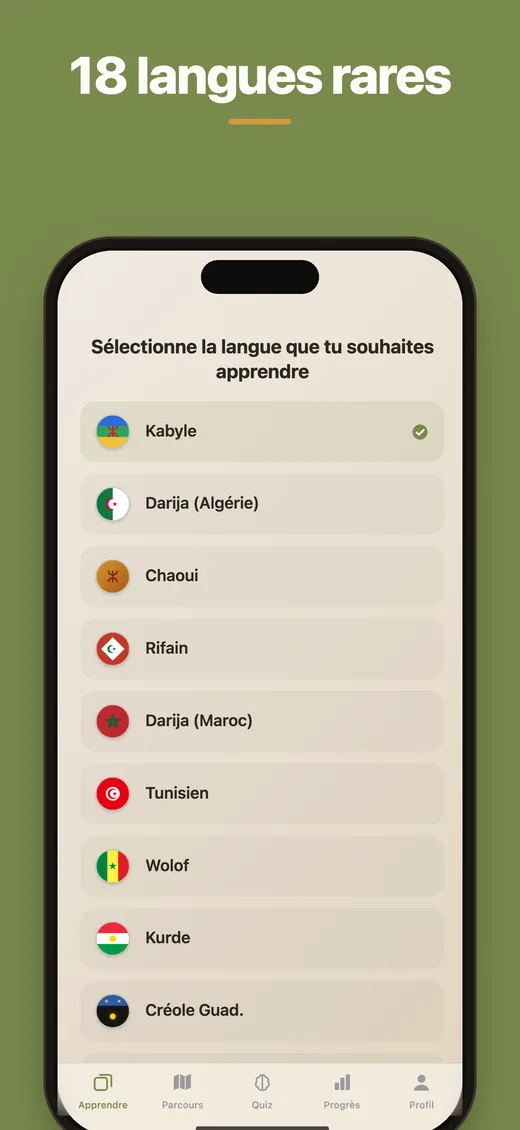
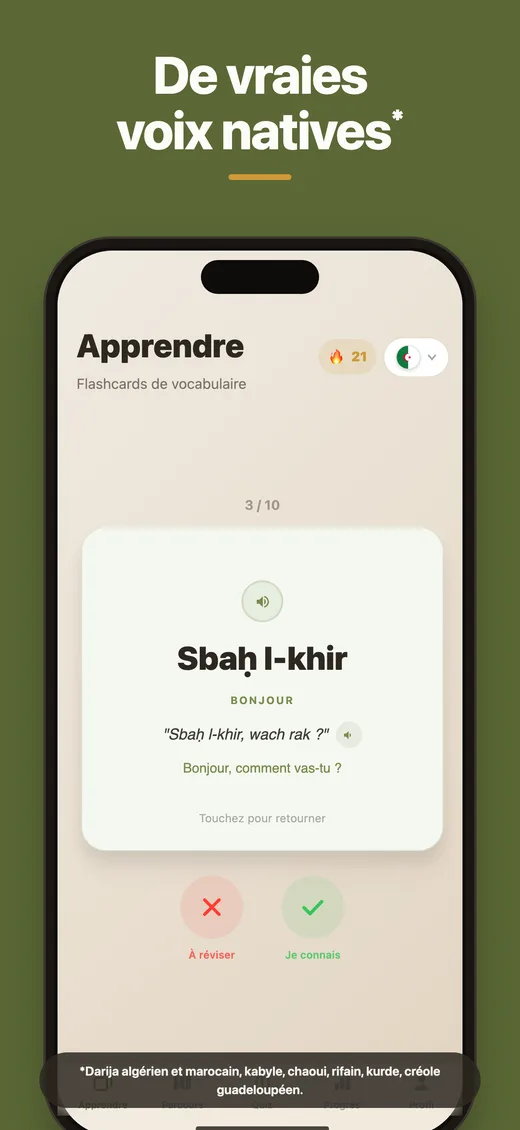
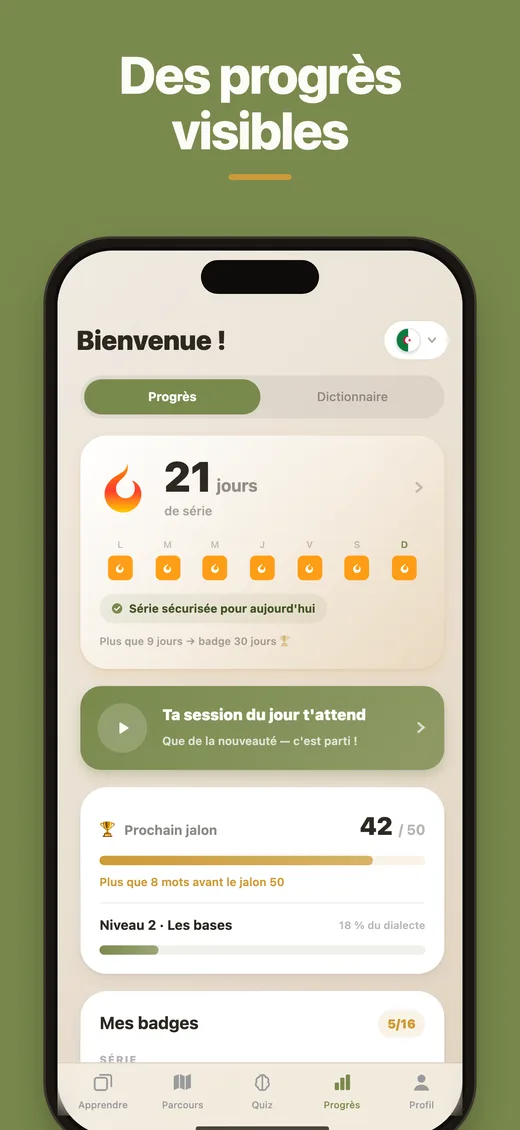
In concrete terms:
- 100% native audio for Chaoui: every word and every example sentence is recorded by real Chaoui speakers. You hear the real ɣ, the real ɛ, the real emphatics — not a synthetic voice that has never existed for this language.
- An enriched Latin script: azul, tanemmirt, with the characters ḍ, ṭ, ɣ, ɛ that faithfully capture Chaoui sounds. Readable immediately, with no need to learn Tifinagh first — that can come later, as a cultural landmark.
- Flashcards, quizzes and level-based tracks with spaced repetition: words you've mastered space out, fragile ones come back at the right moment.
- 5-minute sessions, daily streaks, vocabulary milestones: designed to fit a busy life, between two subway stops or after dinner.
- Free to start, on iPhone and on the web.
An honest inventory: the little that exists for Chaoui
A classic comparison would line up competing apps. For Chaoui, there practically aren't any: the real landscape in 2026 is one app with native audio on one side, and community resources — worthy but scattered — on the other. Here they are, leaving none out:
| Solution | Strengths | Limits for learning Chaoui |
|---|---|---|
| Dialect | 100% native Chaoui audio (words + sentences), spaced repetition, 5-min sessions, structured track, designed for the diaspora, on iPhone, Android and web | No formal grammar course |
| Duolingo / Babbel / Rosetta Stone | Proven methods, huge catalogs | Do not offer Chaoui — or any other Amazigh language. There is quite simply nothing to compare |
| Online classes from cultural associations (e.g. the Réseau culturel franco-berbère, in France) | Real teachers, a structured framework, a precious community dimension | Fixed schedules, limited seats, year-long enrollment; no daily review tool between sessions |
| YouTube and enthusiasts' blogs | Free; Chaoui lesson playlists and blogs (grammar, lexicon) kept by devoted volunteers | No organized progression or planned review; uneven audio quality; resources that sometimes stop being updated |
| Chaoui dictionaries (print or scanned) | Serious lexical references, notably Chaoui-Arabic dictionaries published in the 2000s-2010s | Hard-to-find works, no audio; useful to check a word, not to learn to speak |
| Facebook groups and forums | Direct contact with speakers, genuine mutual help, expressions from the villages | No learning structure; transcriptions that vary from one member to the next; a place to practice, not to start |
This table calls for a clear-eyed reading: those community resources are not competitors, they are allies. They have kept Chaoui alive online for years, often against the odds. An app brings what they cannot offer — structure, systematic audio, planned review — and they bring what an app will never offer on its own: community.
Which solution for your profile?
- You're from the Chaoui diaspora and want to talk with family: Dialect, starting with greetings and kinship words. Then try your first azul on calls back home — there is no better teacher than a grandmother who corrects you with a smile.
- Your parents speak Chaoui but didn't pass it on: the most common case, and the most repairable. Dialect to build the foundation, your parents for practice: many rediscover their own language while helping you.
- Your partner is Chaoui: ten well-pronounced words at the next family gathering will do more than any gift. Start with azul and tanemmirt; the rest will follow.
- You're aiming for deeper knowledge (grammar, writing, Tifinagh): combine Dialect for daily speaking practice with a structured association course, and keep our guide to the Tifinagh alphabet (in French) at hand.
- You're hesitating between Chaoui and Kabyle: choose the language of your family, not the better-documented one. Our guide to which Berber language to learn (in French) helps you decide — and for Kabyle we have a dedicated comparison: the best app to learn Kabyle.
The method that works, whatever the resource
An app provides the framework; the method is what makes you progress. Here is the one we recommend — and that Dialect applies automatically:
- 5 to 10 minutes a day, every day. For a language nobody around you speaks day to day, consistency is your only immersion: don't negotiate it away.
- Native audio from day one. Listen to each word several times, repeat out loud. The sounds ɣ and ɛ only yield to repetition — that's normal, and it comes.
- Trust the reviews. When tanemmirt comes back just as you thought you knew it, it means your memory was about to let it go. The system knew before you did.
- Speak before you feel ready. From your first 50 words on, drop three of them into a family call. For a language so rarely learned by the younger generations, the emotion you'll spark is worth every motivational lesson.
And keep in mind the stake that goes beyond your personal progress: every person who learns Chaoui today makes its silence tomorrow a little less likely. A language transmitted orally for centuries can go extinct in two generations of neglect — or hold on through a thousand modest gestures, your five daily minutes among them.
Frequently asked questions
Can you learn Chaoui with Duolingo or Babbel?
No. Neither Duolingo, nor Babbel, nor Rosetta Stone offers Chaoui — nor any other Amazigh language. That is the whole point of this page: for Chaoui, the question is not which major platform to pick, but what to do when none of them cares.
Are Chaoui and Kabyle the same language?
No. They are two distinct Amazigh languages: Kabyle in Kabylia, Chaoui in the Aurès. They share a real common core, but pronunciation, vocabulary and loanwords differ; mutual understanding is only partial and takes some adjusting. Learning one does not spare you from learning the other.
Is Dialect's Chaoui audio really native?
Yes, 100%: every word and every sentence is recorded by real Chaoui speakers, with no text-to-speech at all. For a language no synthetic voice has ever been trained on, it is the only honest way to do it.
Is Chaoui written in Tifinagh or in Latin letters?
Both coexist. Tifinagh is the historic Amazigh alphabet, with a strong identity charge — its ⵣ adorns flags and jewelry. In everyday use and in linguistic work, it is the enriched Latin alphabet (ḍ, ṭ, ɣ, ɛ) that dominates; Dialect uses it so you can read and pronounce from the very first lesson. Our French-language guide to the Tifinagh alphabet tells the story of this script.
How long does it take to hold a simple exchange in Chaoui?
With 5 to 10 minutes a day, count on a few weeks for your first sentences and 2 to 3 months for simple exchanges: greetings, family news, thanks. The decisive factor is not a gift for languages — it is consistency.
5 minutes a day · 100% native audio · 4.7/5 on the App Store
On a computer? Try the web app →