Best app to learn Rifain in 2026
You're looking for an app to learn Rifain — Tarifit, the Amazigh language of the Rif, in northern Morocco — and you run into a blunt fact: there are almost none. Duolingo, Babbel, Rosetta Stone, Memrise: no major platform offers Tarifit, or indeed any Amazigh language. What does exist boils down to a handful of resources, often community-made, sometimes designed for the Dutch-speaking diaspora of the Netherlands and Belgium rather than for anyone else. This guide takes an honest tour of that sparse landscape, and helps you choose based on your profile.
Quick answer: to speak everyday Rifain — the language of family in Nador or Al Hoceima, of Sunday calls, of summers back home — Dialect is one of the very few apps in the world to offer Tarifit, with 100% native audio: every word and every sentence is recorded by real Rifian speakers, never by text-to-speech. Spaced repetition, 5-minute sessions, rated 4.7/5 on the App Store (August 2026). For a full grammar course, online association classes are a useful complement — details below.
Why Rifain needs a dedicated app
Tarifit is neither Darija nor a "generic Berber"
First confusion to clear up: Rifain is not a dialect of Arabic. It is an Amazigh (Berber) language, from a language family entirely different from Moroccan Darija. A child from Nador who grows up speaking Tarifit is not learning a "variant" of Moroccan Arabic: they speak another language, with its own grammar, vocabulary and sounds.
Second confusion, subtler: Rifain is not interchangeable with the other Amazigh languages either. The Tachelhit of the Souss, the Tamazight of the Middle Atlas and the Kabyle of Algeria share a common core with it, but centuries of separate evolution have made them hard to understand across. An app selling a "Berber" course without saying which one teaches, at best, a language neighboring your family's. Our guide to which Berber language to learn (in French) walks through these differences; if your family comes from the Rif, the answer is simple: Tarifit is what you need, and nothing else.
A pronunciation that belongs to the Rif alone
Rifain has pushed certain sound changes further than its cousins. The best known: in most varieties of the central Rif, the l of common Berber is pronounced r — where Kabyle says ul (the heart), Rifain says ur. Linguists also describe a "spirantization" of consonants: sounds like k soften, so that the word for "sun", tfukt elsewhere, becomes tfuyt across much of the Rif. Add the emphatic consonants ḍ and ṭ, the ɣ (close to a French guttural r) and the ɛ (the ʿayn), none of which exist in English.
The practical consequence: no written transcription is enough, and no text-to-speech engine has been seriously trained on Tarifit. These sounds can only be acquired by hearing them pronounced by real Rifian speakers, several times, in real words. That is the criterion that rules out most of the few existing resources from the start.
An orally transmitted language, under strain in the diaspora
Rifain was passed down for centuries almost exclusively by word of mouth, generation after generation. In the diaspora — massive in France, Belgium, the Netherlands and Spain — that chain is stretching thin: the grandparents speak Tarifit, the parents understand it, the grandchildren often keep only a few words. Unlike Arabic or Spanish, there are no school classes, no mainstream course catalogs, no Netflix library to compensate. And a notable share of the existing community resources was created in the Netherlands, in Dutch — not much help if that's not a language you read.
For someone whose family comes from the Rif, a dedicated app is therefore not a convenience: it is just about the only structured tool available for relearning your parents' language without waiting for next summer back home.
The 4 criteria of a good Rifain app
- Audio recorded by real Rifian speakers — not a synthetic voice, not a speaker of another Amazigh language. Your ear calibrates on what it hears: if it hears an l where your grandmother says r, you're learning a different language from hers.
- Everyday vocabulary first — greetings, family, food, emotions. You're learning to say azul to your grandfather and understand his answer, not to book a hotel.
- A real memorization system — spaced repetition brings each word back just before you forget it. Without it, vocabulary lists evaporate within weeks.
- Short sessions and visible progress — 5 minutes a day kept up for 3 months beats an hour every Sunday abandoned in January. Daily streaks, milestones, badges: the app should make consistency easy.
Dialect in practice, with screenshots
Dialect was built precisely for this use case: the diaspora that wants to speak the family's language (again), including when that language interests no major platform. Rifain appears there among 19 rare languages, treated as a language in its own right — distinct from Tachelhit, from Kabyle and of course from Darija.
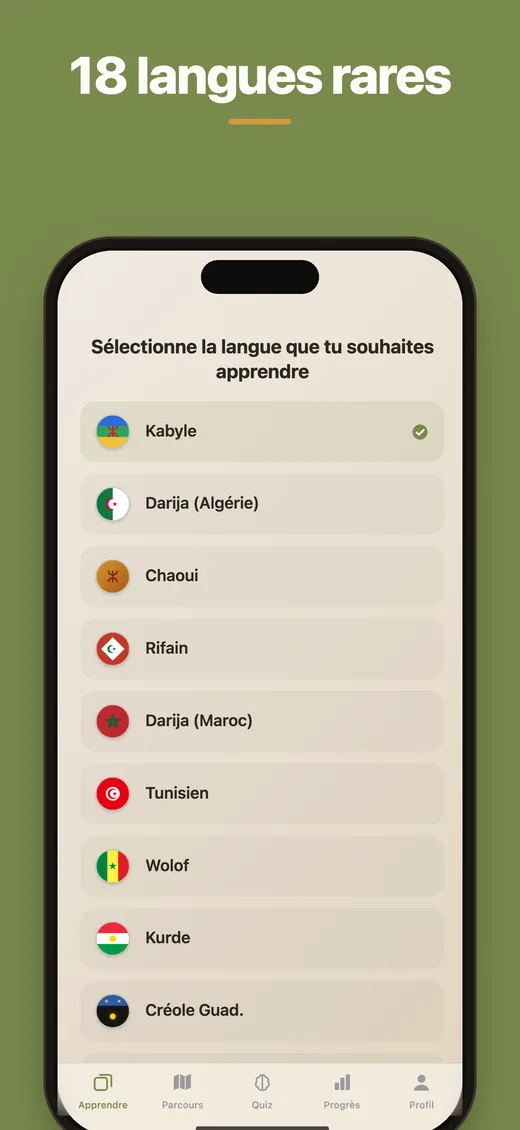
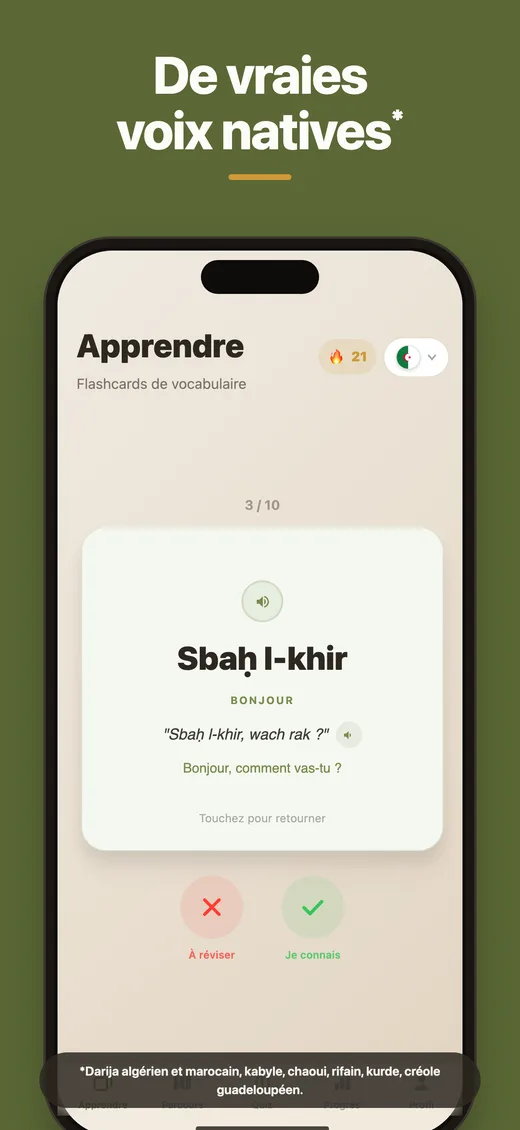
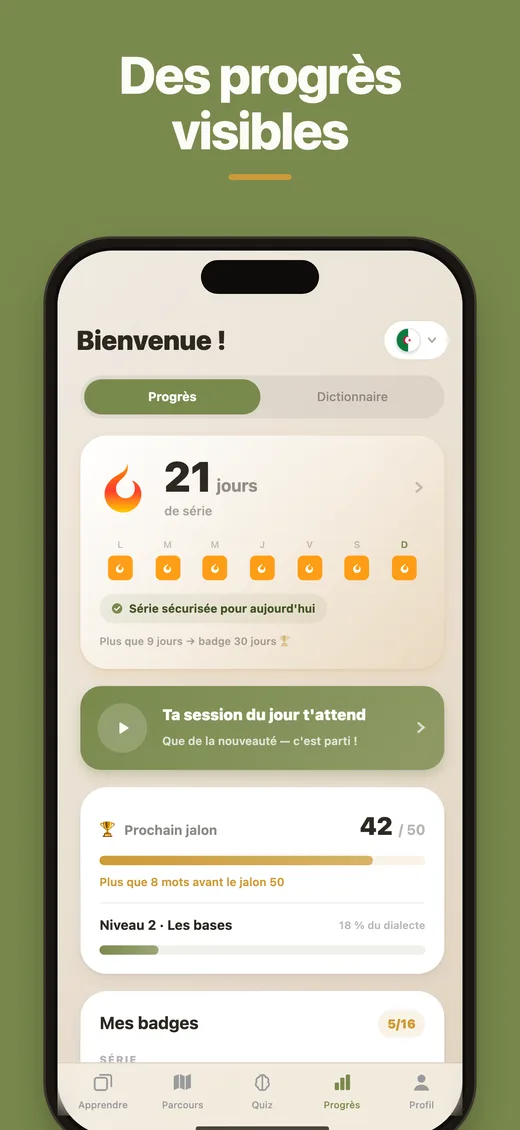
In concrete terms:
- 100% native audio for Rifain: every word and every example sentence is recorded by real Rifian speakers — no text-to-speech, at any point. You hear the real ɣ, the real ɛ, the r where the Rif says r.
- A Latin script you can read immediately: azul, tanemmirt, with the characters ḍ, ṭ, ɣ, ɛ to faithfully capture the sounds of Tarifit. No need to master Tifinagh (guide in French) to start speaking — it can come later, as one more pleasure.
- Flashcards, quizzes and level-based tracks with spaced repetition: the words you know space out, the ones that resist come back more often.
- 5-minute sessions, daily streaks, vocabulary milestones (50, 100, 200 words…): designed to fit a busy life, between two subway stops.
- Free to start, on iPhone and on the web.
An honest comparison of the alternatives
The real landscape in 2026 fits in a short table — that is precisely the problem:
| Solution | Strengths | Limits for Rifain |
|---|---|---|
| Dialect | 100% native Rifain audio (words + sentences), spaced repetition, 5-min sessions, designed for the diaspora, on iPhone, Android and web | No formal grammar course |
| Duolingo / Babbel / Rosetta Stone / Memrise | Proven methods, huge catalogs | Do not offer Rifain — or any Amazigh language. Their "Arabic" (Standard Arabic) will be of no use for understanding Tarifit |
| uTalk / EuroTalk ("Tarifit Berber") | One of the only other apps to cover Tarifit; themed word and phrase lists, memory games | Generic content translated from a template shared by every language in the catalog, with no cultural adaptation; no progressive track or planned spaced repetition |
| Online classes from cultural associations (e.g. the Réseau Culturel Franco-Berbère, in France) | Real teachers, structured grammar, a full year from September to June | Fixed schedules, year-long commitment, a school rhythm: excellent as a complement, hard to sustain alone for an eager beginner |
| YouTube, dictionaries and community resources | Free, genuinely passionate creators, authentic immersion | No structure or review, uneven quality, and part of the material is in Dutch (Netherlands diaspora): precious as backup, insufficient on its own |
Which solution for your profile?
- You're from the Rifian diaspora and want to talk with family: Dialect, starting with greetings and family vocabulary. Round it out with calls to your relatives — no exercise beats the smile of a grandmother who hears azul.
- You also want grammar in depth: Dialect for the daily spoken foundation and memorization, plus a year-long online association course for conjugation and syntax.
- Your family is Amazigh but not Rifian (Souss, Middle Atlas, Kabylia): don't learn Tarifit by default — see our guide to which Berber language to learn (in French) to choose the language of your region, and for Kabyle, our dedicated comparison of the best app to learn Kabyle.
- You're curious about writing and heritage: start with the spoken language on Dialect, then explore the Tifinagh alphabet (guide in French), the historic script of Amazigh, official in Morocco.
The method that works, whatever the app
An app is not everything: method is what makes you progress. Here is the one we recommend — and that Dialect applies automatically:
- 5 to 10 minutes a day, every day. For a language with no possible immersion in your daily life, consistency matters even more than for English or Spanish.
- Audio from day one. Listen to each word several times, repeat out loud. The sounds of Tarifit only sink in through the ear and the mouth, never through the eyes alone.
- Trust the reviews. When a word comes back just as you thought you knew it, that is precisely the moment your memory needed it.
- Speak before you feel ready. From 50 words on, drop azul and tanemmirt into a family call. In the diaspora, every word of Rifain spoken is an act of transmission — your relatives know it, and they will give it back a hundredfold.
Frequently asked questions
Can you learn Rifain with Duolingo or Babbel?
No. Neither Duolingo, nor Babbel, nor Rosetta Stone offers Rifain — nor any Amazigh language. Their "Arabic" courses teach Modern Standard Arabic, which belongs to a different language family from Tarifit and won't help you understand your family from the Rif.
Rifain or Moroccan Darija: which should you learn?
They are two different languages: Rifain is Amazigh, Darija is a colloquial Arabic. If your family speaks Tarifit at home, Rifain is the one that will reconnect you with your own — Darija, Morocco's lingua franca, can come second. Many diaspora learners do both, but start with the language of the heart.
Is Rifain written in Tifinagh, Arabic script or Latin letters?
All three coexist. Tifinagh is the official alphabet of Amazigh in Morocco, but the diaspora mostly writes Rifain in Latin letters, with a few special characters (ḍ, ṭ, ɣ, ɛ) for the sounds English doesn't have. Dialect uses this Latin script: you speak first, and our guide to the Tifinagh alphabet (in French) is waiting when you want to go further.
Can a Rifian and a Kabyle understand each other?
Only partially. The two languages share a common Amazigh core, but the evolutions specific to the Rif — including the famous l pronounced r in most varieties — and vocabulary differences make conversation hard without practice. That is exactly why an undifferentiated "Berber" course is no substitute for a Tarifit course.
Is Dialect's Rifain audio really native?
Yes, 100%: every word and every example sentence is recorded by real Rifian speakers, with no text-to-speech at all. For a language as poorly served digitally as Tarifit, that is criterion number one — and the rarest.
5 minutes a day · 100% native audio · 4.7/5 on the App Store
On a computer? Try the web app →
Further reading
- Learn Rifain: vocabulary and native audio
- Best app to learn Kabyle in 2026
- Spaced repetition: the science behind the method
- Learning your heritage language as an adult
- Which Berber language to learn (in French)
- Best app to learn Chaoui in 2026
- Best app to learn Moroccan Darija in 2026
- Ce guide en français