Best app to learn Lingala in 2026
You're looking for an app to learn Lingala — the great Bantu language of Kinshasa, Brazzaville and Congolese rumba — and you quickly run into the problem: the major platforms like Duolingo and Babbel simply don't offer it. For a language spoken by tens of millions of people in the Democratic Republic of the Congo, in Congo-Brazzaville and across a worldwide diaspora, the options come down to a handful of small apps and some YouTube channels. This guide takes an honest tour of what actually exists, and helps you choose based on your profile.
Quick answer: to speak everyday Lingala — the language of family, of calls back home, of the songs you've hummed since childhood — Dialect is the most direct app: everyday vocabulary and sentences with clear audio on every word and every sentence, spaced repetition and 5-minute sessions. Rated 4.7/5 on the App Store (August 2026). For themed phrase lists or a formal course, other resources are useful complements — details below.
Why Lingala needs a dedicated app
A major language ignored by the major platforms
Lingala is one of the four national languages of the DRC and one of the two of Congo-Brazzaville. A lingua franca born along the Congo River, it is today the language of Kinshasa — one of the largest cities in the world —, the language of the street, the markets, the army and above all the music: Congolese rumba, inscribed on UNESCO's intangible heritage list, and ndombolo have been sung in Lingala for decades. Yet neither Duolingo, nor Babbel, nor Rosetta Stone teaches it. For the children of the Congolese diaspora — from Château Rouge in Paris to Matonge, the Congolese quarter of Brussels, to the Congolese communities of London and North America — who understand their parents' language without daring to speak it, an app that takes Lingala seriously is overdue.
A Bantu grammar: regular, but different
Lingala belongs to the Bantu family: its logic is neither that of English nor that of French. Nouns sort into noun classes marked by prefixes — moto (a person) becomes bato (people), eloko (a thing) becomes biloko (things). The verb, meanwhile, is built by stacking regular prefixes: na- for "I", o- for "you", a- for "he/she" — hence nazali malamu ("I'm well") and ozali malamu? ("are you well?"). The good news: this machinery is remarkably regular, far more so than European conjugations. But it can't be guessed — a generic course designed for Spanish or German will never teach it to you. Add the distinction between everyday Lingala (known as "easy Lingala", the language of Kinshasa and the music, peppered with French loanwords) and classical Lingala with its full class agreement, reserved for writing, church and formal media: a serious app has to choose to teach the language people actually speak first.
A pronunciation you tame by ear
Lingala distinguishes seven vowels, including the open vowels ɛ and ɔ that everyday spelling writes simply as "e" and "o": mbɔ́tɛ (hello) doesn't sound the way "mbote" looks on the page. Add consonant onsets that are unusual at the start of a word for an English speaker (mb-, nd-, ng-) and a melodic accent inherited from Bantu tones. No transcription renders all of this faithfully: you have to listen, a lot. Listen to real speakers around you — family, concerts, rumba from Franco to Fally Ipupa, Congolese YouTube channels — and demand of your app audio on every word, not just on a few introductory sentences.
The 4 criteria of a good Lingala app
- Audio on every word and every sentence — not just on an introductory lesson. Your ear calibrates on what it hears: the vowels ɛ and ɔ, the onsets mb- and ng- are only acquired through repeated listening.
- Everyday vocabulary first — greetings, family, food, the market. Not "the airport" and "the hotel booking" in lesson 2: you're learning Lingala to talk to people, not for a business trip.
- A real memorization system — spaced repetition brings each word back at the optimal moment before you forget it. Without it, you retain 20% of what you study.
- Short sessions and visible progress — 5 minutes a day kept up for 3 months beats an hour every Sunday abandoned in January. The app should make consistency easy (streaks, milestones, reminders).
Dialect in practice, with screenshots
Dialect was built precisely for this use case: diaspora members and spouses who want to speak the family's language (again). Lingala is one of its 19 languages rarely taught anywhere else, organized into level-based tracks.
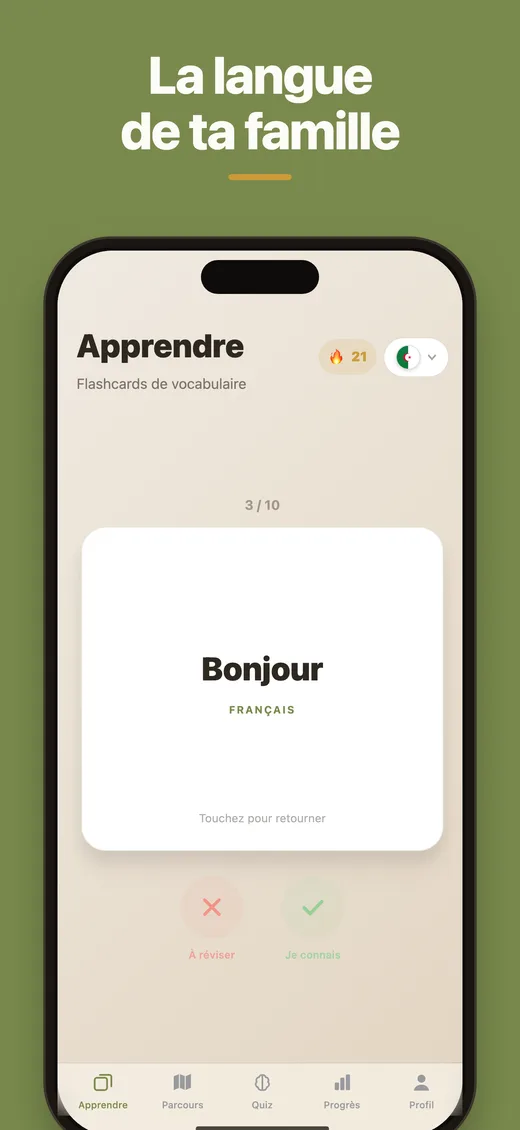
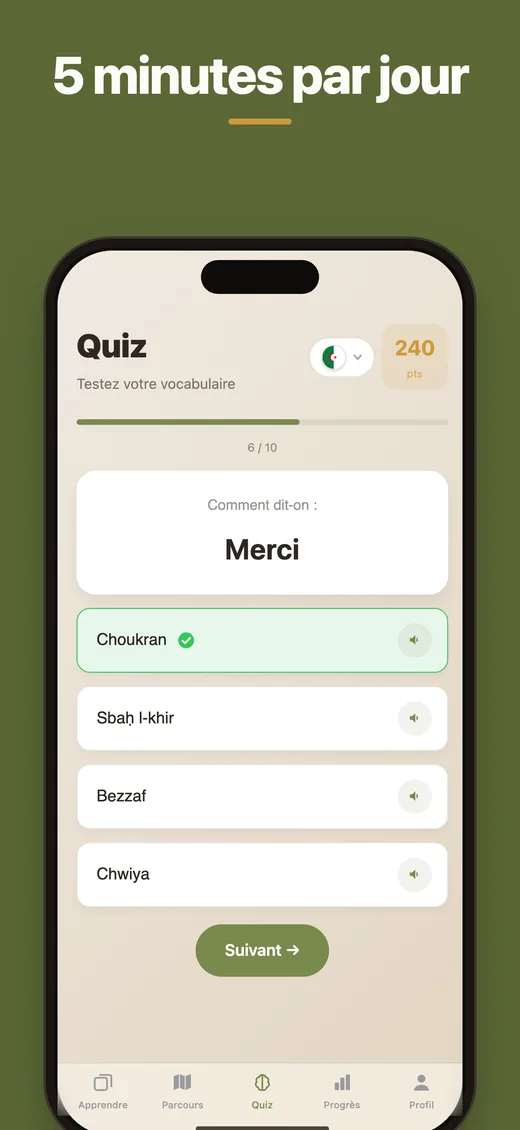
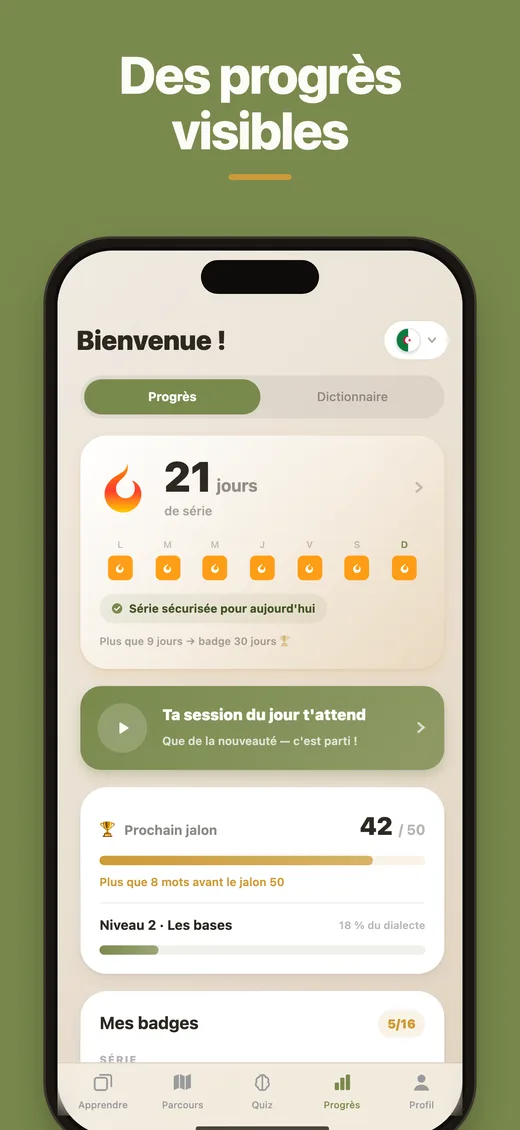
In concrete terms:
- Clear audio on every word and every sentence: you hear mbote, matondo, ozali malamu? as many times as you need, and every example sentence can be listened to as well.
- The Lingala people actually speak: the language of family conversations and of the music, in everyday Latin script — not a bookish Lingala.
- Flashcards, quizzes and level-based tracks with spaced repetition: easy words space out, hard ones come back.
- 5-minute sessions, daily streaks, milestones (50, 100, 200 words…): built to fit a busy life.
- Free to start, on iPhone and on the web.
An honest comparison of the alternatives
No app is perfect for everyone. Here is the real landscape in 2026:
| Solution | Strengths | Limits for Lingala |
|---|---|---|
| Dialect | Designed for the diaspora, everyday vocabulary, clear audio on every word and every sentence, spaced repetition, 5-min sessions, on iPhone, Android and web | No formal grammar course |
| Duolingo / Babbel / Rosetta Stone | Proven methods, huge catalogs | Do not offer Lingala. None of the three major platforms covers this language in 2026 |
| uTalk | Lingala does appear in its catalog of 150+ languages, phrases sorted by theme | Generic method identical for every language, no reviews scheduled over time, not designed for the diaspora |
| Small vocabulary apps and dictionaries (Français Lingala, Lingala…) | Free or cheap, handy for translating the occasional word | Word lists more than methods: variable audio quality, no structured track and no memorization tracking |
| YouTube / Congolese music | Free, real immersion with real speakers, rumba and ndombolo as pronunciation teachers | No structure and no review system: perfect as a complement, insufficient on its own for durable memorization |
| Multi-language African apps | Several African languages in one app, short lessons | Very broad catalog: check how many words and sentences exist for your language, and what stays available without a subscription |
Which solution for your profile?
- You're from the Congolese diaspora and want to talk with family: Dialect, starting with greetings and family vocabulary. Add calls back home and family meals — the best practice lab there is.
- You're moving to Kinshasa or Brazzaville to live or work: Dialect for the everyday spoken foundation, plus a structured course (textbook, online class) for noun-class grammar and writing.
- Your partner or in-laws speak Lingala: ten minutes a day is enough to drop mbote, matondo mingi and a few sentences at the next family meal — the effect is guaranteed.
- You love rumba and want to understand the lyrics: Dialect for the core vocabulary, your playlists for immersion. Recognizing your first words in a Fally Ipupa song is a formidable motivator.
- You just want a few phrases before a trip: our free guides (how to say hello in 15 languages) and a week of Dialect cover the basics of politeness.
The method that works, whatever the app
An app is not everything: method is what makes you progress. Here is the one we recommend — and that Dialect orchestrates automatically:
- 5 to 10 minutes a day, every day. Consistency beats intensity, with no known exception in the research.
- Audio from day one. Listen to each word several times, repeat out loud — even alone in your kitchen. And immerse yourself in real voices: family, rumba, Congolese videos.
- Trust the reviews. When a word comes back just as you thought you knew it, that is exactly when your memory needed it.
- Speak before you feel ready. From 50 words on, drop mbote and matondo mingi into a family call. The smiles you'll get are worth all the badges.
Frequently asked questions
Can you learn Lingala with Duolingo or Babbel?
No. Neither Duolingo, nor Babbel, nor Rosetta Stone offers Lingala in 2026. For this language spoken by tens of millions of people in the DRC and Congo-Brazzaville, you have to turn to specialized apps like Dialect, to uTalk, or to scattered online resources.
What is the best app to learn Lingala?
It depends on your goal. To talk with family and understand everyday conversations, Dialect offers Lingala vocabulary and sentences with clear audio on every word and every sentence, a spaced repetition system and 5-minute sessions. uTalk or YouTube channels can complement it depending on your profile.
Is Lingala hard to learn?
Lingala has a reputation for being accessible: no endless irregular conjugations, a regular structure of prefixes (na- for I, o- for you, a- for he or she) and many French loanwords. The new elements for most learners are the Bantu noun-class system (moto → bato) and the open vowels ɛ and ɔ, which are acquired by ear with regular listening.
How long does it take to hold a simple conversation in Lingala?
With regular practice of 5 to 10 minutes a day, most learners can handle simple exchanges (greetings, family, news) within 2 to 3 months: mbote, ozali malamu?, matondo mingi. Consistency matters more than session length: that is the principle of spaced repetition.
Should you learn easy Lingala or classical Lingala?
To talk with family and the diaspora, start with everyday Lingala, known as "easy Lingala": the language of Kinshasa, Brazzaville and Congolese music, with its French loanwords. Classical (literary) Lingala, with its fuller class agreement, is used mostly in writing, in church and in formal media; it can come later.
Is the Lingala audio in Dialect recorded by native speakers?
Yes. For Lingala, every word and every sentence is recorded by Harvey, a native speaker: no synthetic voice. Because Lingala is a tonal language, do add real listening too — Congolese rumba is the best immersion there is, and it is everywhere.
5 minutes a day · Free to start · 4.7/5 on the App Store
On a computer? Try the web app →