Why learn Lingala?
Lingala is a Bantu language spoken in the Democratic Republic of the Congo (Kinshasa, the west and northwest) and in the Republic of the Congo (Brazzaville and the north), and it is a national language in both countries. It is written in the Latin alphabet, with two extra vowels, ɛ and ɔ. “Hello” in Lingala is mbote , “thank you” is matondi and “goodbye” is tokomonana. More on the Lingala language: where it is spoken and how it is written.
Lingala is the language of Kinshasa and of the Congolese musical revolution (rumba, soukouss, ndombolo) that has shaped African and world music for decades. For up to 40 million speakers, it's a daily lingua franca; for the diaspora, it's a vibrant cultural bridge.
Whether you are part of the diaspora or simply passionate about world languages, Dialect gives you the tools to progress quickly.
The Dialect Method
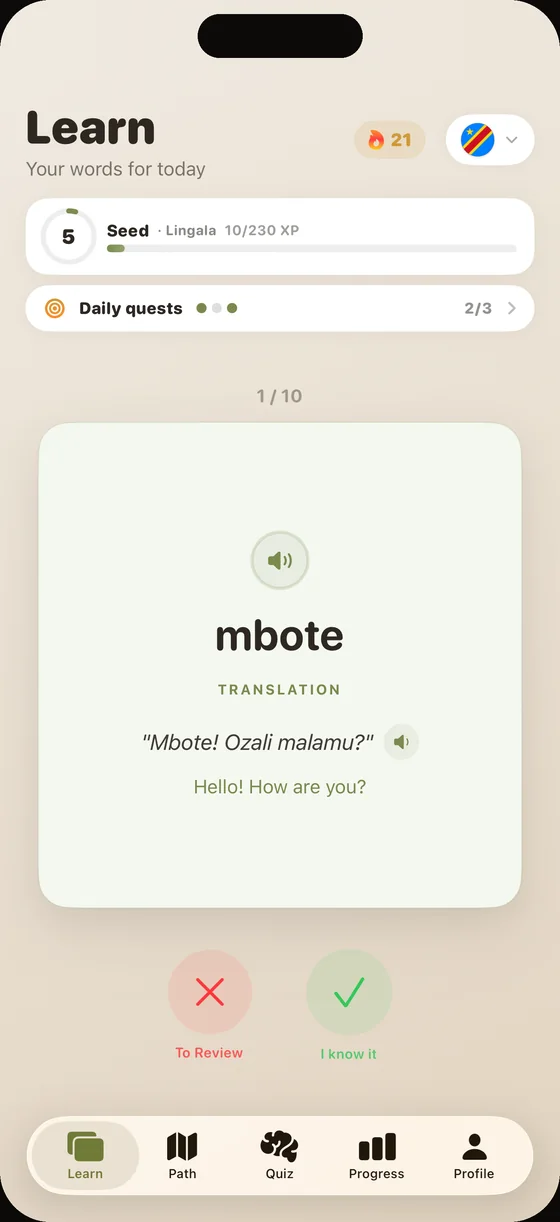
Our app combines playful learning with linguistic rigor:
- Essential vocabulary: learn the words most used in everyday life.
- Harvey's voice: every word and every sentence is recorded by Harvey.
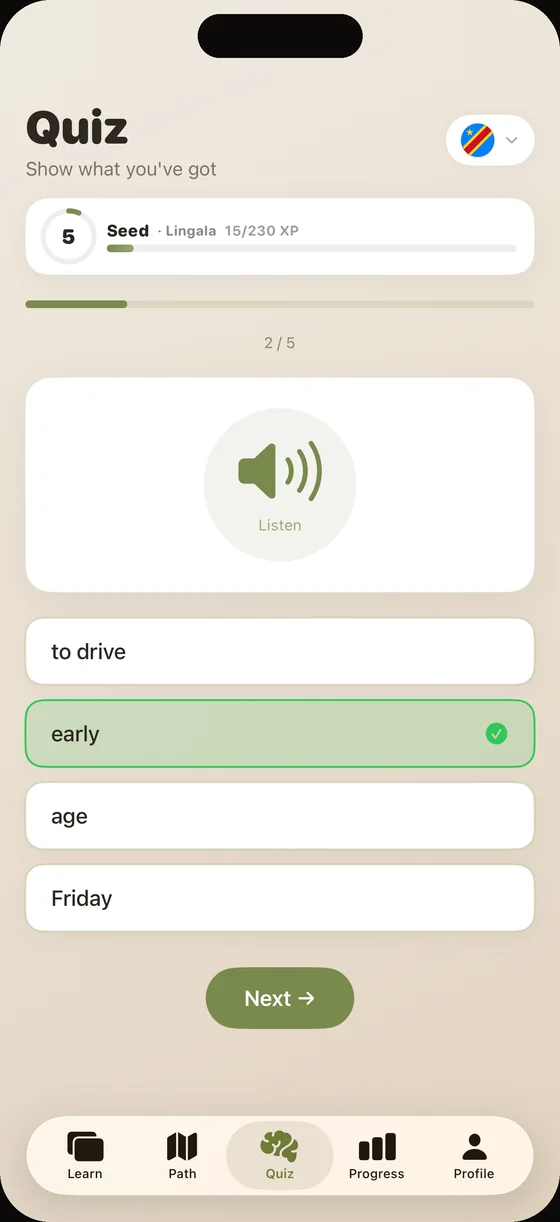
- Interactive quizzes: test your knowledge and track your progress.
- Review mode: never lose what you've already learned.
The Science Behind Dialect
To be among the best educational resources, Dialect builds on cognitive neuroscience principles:
- Spaced Repetition System (SRS): our algorithm calculates the optimal time to review each word, right before you would forget it.
- Harvey's voice: every word comes with Harvey's recording to guide your pronunciation.
- Granular learning: we break dialects into manageable units to prevent cognitive overload.
Lingala in a few facts
- Language family: Bantu language (northwest branch).
- Speakers: around 20 million native speakers, and up to 40 million with second-language speakers.
- Main regions: Democratic Republic of Congo (Kinshasa, Equateur), Republic of Congo (Brazzaville), borders with Angola and Central African Republic.
- Writing systems: Latin alphabet.
Lingala emerged in the 19th century along the Congo River as a trade lingua franca, then became the principal language of Kinshasa and Congolese music. Its typical Bantu structure relies on class prefixes and a rich verbal system of aspects and tenses.
10 everyday Lingala words
The vocabulary people actually use at home or at the market. The right-hand column gives the full sentence in Lingala, exactly as it appears in the app, in Harvey's voice.
| English | Lingala, in Harvey's voice |
|---|---|
| water | mayi “Mela mayi, nabondeli yo.” — Drink some water, please. |
| to eat | kolia “Lia malamu.” — Eat well. |
| to drink | komela “Mela mayi.” — Drink water. |
| home | ndako “Nazali na ndako.” — I am home. |
| mother | mama “Mama na ngai azali na ndako.” — My mother is at home. |
| father | tata “Tata na ngai azali na ndako.” — My father is at home. |
| child | mwana “Mwana azali na ndako.” — The child is at home. |
| market | zando “Nasombaka na zando.” — I do my shopping at the market. |
| tomorrow | lobi “Lobi tokokoma.” — Tomorrow, we'll write. |
| a lot | mingi “Ezali mingi mpo na ngaï.” — That's too much for me. |
Lingala spread through the 20th century as the language of the river, the army and then music: Congolese rumba carried it far beyond Kinshasa and Brazzaville.
How Dialect makes learning Lingala easier
Learning a heritage language when you live in the diaspora has unique challenges: few structured resources, materials often aimed at linguists rather than daily learners, and a critical shortage of reliable audio recordings. Dialect was built to address these obstacles.
Specifically for Lingala, the app provides:
- Progress by frequency of use: you first learn words and phrases you will actually hear.
- Harvey's voice: the same speaker from session one.
- Short sessions (5 cards a day): consistency beats intensity.
- Smart review: the spaced repetition algorithm presents each word right before you would forget it.
Hello, thank you and essential phrases in Lingala
Hello in Lingala is mbote , at any time of day. “Thank you” is matondi, “goodbye” is tokomonana, and to ask “how are you?” you say boni? Here are the must-know greetings and polite phrases, as Harvey says them in the app:
| English | Lingala, in Harvey's voice |
|---|---|
| hello | mbote “Mbote, ozali malamu?” — Hello, how are you? |
| hi | mbote “Mbote, sango nini?” — Hi! What's new? |
| how are you | boni? “Boni, malamu?” — How are you, good? |
| I'm fine | nazali malamu “Nazali malamu, matondi na Nzambe.” — I'm fine, thank God. |
| and you | ebongo yo? “Ebongo yo, sango nini?” — And you, what's new? |
| thank you | matondi “Matondi mpo na likabo.” — Thank you for the gift. |
| you're welcome | tiká, ezali eloko te “Tiká, ezali eloko te.” — You're welcome. |
| please | nabondeli yo “Nabondeli yo, pesa ngaï maï.” — Please give me some water. |
| sorry | bolimbisi “Limbisa ngai, namonaki yo te.” — Sorry, I didn't see you. |
| excuse me | limbisa ngai “Limbisa ngaï pona retard.” — Excuse me for being late. |
| yes | iyo “Iyo, nakoya.” — Yes, I agree |
| no | te “Nazali koyaka te.” — I'm not coming. |
| goodbye | tokomonana “Tokomonana, mibatela.” — Goodbye, take care. |
| see you tomorrow | tokomonana lobi “Tokomonana lobi.” — See you tomorrow. |
| see you soon | tokomonana kala mingi te “Tokomonana kala mingi te.” — See you soon. |
| welcome | boyei malamu “Boyei malamu epayi na biso.” — Welcome to our home. |
| good night | butu malamu “Lekisa butu malamu.” — Have a good night. |
Spelling as Harvey writes it in the app. For the full vocabulary, download the Dialect app or open the web app on desktop.
Hear Lingala: family, the market and everyday courtesy
Words you will hear at home, at the market or at the table, each followed by an example sentence from the app. Press Listen to hear Harvey, a native Lingala speaker.
| English | Lingala, in Harvey's voice |
|---|---|
| brother | ndeko ya mobali “Ndeko na ngaï ya mobali azali na mboka.” — My brother is back home. |
| sister | ndeko ya mwasi “Ndeko na ngaï mwasi azali na engumba.” — My sister is in town. |
| friend | moninga “Moninga na ngai ayé na ndako.” — My friend came over. |
| country | mboka “Mboka na ngai ezali Congo.” — My country is Congo. |
| money | mbongo “Azali na mbongo te.” — He has no money. |
| price | talo “Talo nini?” — What's the price? |
| how much is it | ezali talo boni? |
| to buy | kosomba “Nakéï kosomba lipa.” — I'm going to buy some bread. |
| enjoy your meal | lia malamu |
| congratulations | longonya “Longonya mpo na libala na yo.” — Congratulations on your wedding. |
| I don't understand | nasosoli te “Nasosoli ewano na yo te.” — I don't understand your question. |
| gently | malembe “Tambola malembe.” — Walk gently. |
What these examples tell you about Lingala
Several features of Lingala show up in these examples. Verbs are quoted with the prefix ko- (kosomba, to buy), and the subject is attached to the verb: na- for “I” (nasosoli te, I don't understand), o- for “you” (ozali). The negation te comes at the end of the sentence. “Brother” and “sister” use the same word, ndeko, which the app also uses for “cousin”; you add ya mobali (male side) or ya mwasi (female side).
Like other Bantu languages, Lingala sorts its nouns into classes marked by prefixes. People often distinguish the Lingala of Kinshasa, which readily forms plurals with ba (ba talo, prices) and is full of French words (négociation, billet, retard), from a more standardised “literary” Lingala, linked to usage in the Équateur region, which keeps more class agreement. Lingala is also a tonal language, with high and low tones that everyday spelling almost never marks (tiká is an exception): two words spelt the same can differ only by tone, which is why listening beats reading.
At the market: a short conversation
The customer says hello and asks the price, the seller praises her market, the customer finds it too expensive… and they strike a deal. Every line is a sentence from the app, word for word, in Harvey's voice.
- Customer: Mbote, sango nini? Hi! What's new?
- Seller: Nazali malamu, matondi na Nzambe. I'm fine, thank God.
- Customer: Na ko zwa yango, ezali talo boni? I'll take it, how much is it?
- Seller: Zando oyo ezali na ba talo moke. This market is cheap.
- Customer: Ezali talo mingi. It's too expensive.
- Seller: Malamu, ekotambola. Okay, that works.
Spelling as Harvey writes it in the app (you will see both ngai and ngaï). Go further: the Lingala language: history and writing, how to learn Lingala and the best app to learn Lingala.
Frequently asked questions about learning Lingala
How do you say hello in Lingala?
In Lingala, “hello” is “mbote”, at any time of day. To ask how someone is doing in the same breath: “Mbote, ozali malamu?” (Hello, how are you?). Hear it in Harvey's voice above on this page.
How do you say thank you and goodbye in Lingala?
“Thank you” is “matondi” and “goodbye” is “tokomonana”. “See you tomorrow” is “tokomonana lobi”.
Where is Lingala spoken?
In the Democratic Republic of the Congo (Kinshasa, the west and northwest) and in the Republic of the Congo (Brazzaville and the north). It is a national language in both countries, and you hear it in Congolese families abroad, in France, Belgium, the UK and elsewhere.
How long does it take to learn the basics of Lingala?
With Dialect, practicing 5 to 10 minutes a day, you can master essential Lingala vocabulary in 4 to 6 weeks.
Is the Dialect app free?
Dialect is free to start: every day you get one session, one quiz and the Greetings lesson of the Path. Premium unlocks everything.
Is the Lingala audio available in the Dialect app?
Yes. Every word and every sentence is recorded by Harvey, a native Lingala speaker. There is no synthetic voice: you hear the language as it is spoken in Kinshasa and Brazzaville.
Do I need to know any Bantu language to start?
No. Dialect is designed for complete beginners.
Is Dialect available on Android?
Yes. The app is on Google Play. On desktop, Dialect runs directly in your browser through the web app (mydialect.io/app): same languages, the same audio, the same account. The native app is available on iPhone and iPad from the App Store.
Learning Lingala: the essentials
Neither Duolingo, nor Babbel, nor Memrise offers a Lingala course. It exists on uTalk, which teaches vocabulary and phrases rather than a structured course, and through a handful of private tutors — the offering stays thin. Dialect covers Lingala with 997 words and phrases and 1,973 audio files recorded by Harvey, a native Lingala speaker, grouped by theme and reviewed with spaced repetition. The app is free for one session per day per language, on iPhone, iPad, Android and the browser.
Discover other languages on Dialect
Dialect offers 19 heritage languages to reconnect with your roots:
Start for free, today
Free daily session. On iPhone via the App Store, on Android via Google Play, or straight in the browser on desktop.

 Scan with your phone · iPhone or Android
On a computer?
Open the web application