Best app to learn Turkish in 2026
Good news if you want to learn Turkish: unlike rare languages, you're spoiled for choice. Duolingo, Babbel, Mondly and other big platforms offer it, with genuine strengths. So the question is not "which app exists?" but "which one matches your goal?". Following a full grammar course from scratch and reconnecting with the language you hear at family meals are two different projects — and they don't call for the same tools. This guide compares the options honestly and helps you choose based on your profile.
Quick answer: for a complete, progressive Turkish course, Duolingo (free) and Babbel (subscription-based) are solid choices. For the Turkish diaspora who first want the everyday vocabulary of family life — talking with the grandparents, following the conversations at the table — Dialect is the most direct tool: 5-minute sessions, flashcards and quizzes with spaced repetition, clear audio on every word and every sentence. Rated 4.7/5 on the App Store (August 2026), free to start.
Why Turkish deserves a tailored approach
An agglutinative language: it all happens in the suffixes
Turkish is a Turkic language, unrelated to English or French. Its grammar works by agglutination: suffixes stack up at the end of the word to express what English says with prepositions and pronouns. Ev (the house) becomes evler (the houses), evimiz (our house), evlerimizde (in our houses). Add to that vowel harmony: the vowels of the suffixes match those of the word, which gives Turkish its instantly recognizable musicality. It is a fascinatingly regular system — almost no exceptions — but disorienting in the first weeks. The practical consequence: memorizing whole everyday sentences, heard and repeated, gets you further at the start than learning declension rules by heart.
The language of a large diaspora — and of a third generation that understands without speaking
Turkish is one of the great languages of immigration in Europe: several hundred thousand speakers and descendants in France, even more in Germany. In many families who arrived in the 1960s-1980s, the third generation lives a well-known situation: you understand the grandparents' Turkish — gel (come), afiyet olsun (enjoy your meal), canım (my dear) — but you answer in another language. The vocabulary you're missing is not the textbook kind ("the airport", "the meeting"): it's the vocabulary of greetings, family, meals, Sunday phone calls. An app designed for this profile has to start exactly there.
A Latin alphabet, a regular pronunciation: the ear is still the key
More good news: since 1928, Turkish has been written in a Latin alphabet, enriched with a few letters of its own — ı (the dotless i), ş, ğ, ç, ö, ü. No new alphabet to learn, and spelling that is pronounced exactly as written. But some distinctions can only be caught by ear: the difference between i and ı, the ğ that lengthens the vowel rather than being pronounced, the melody of vowel harmony. Hence a simple criterion: the app must offer audio on every word and every sentence, replayable at will, not just text.
The 4 criteria of a good Turkish app
- Audio on every word and every sentence — your ear calibrates on what it hears. Without repeated listening, there is no internalizing teşekkür ederim or the difference between i and ı.
- Everyday vocabulary first — greetings, family, meals, emotions. If your goal is to talk with your relatives, a program that starts with "booking a hotel" will cost you weeks.
- A real memorization system — spaced repetition brings each word back at the optimal moment before you forget it. Essential for a language with no transparent cognates.
- Short sessions and visible progress — 5 minutes a day kept up for 3 months beats an hour every Sunday abandoned in January. Streaks, milestones, reminders: consistency should be easy.
Dialect in practice, with screenshots
Dialect was built for one precise use case: diaspora members and spouses who want to speak the family's language (again). No cartoons, no league races: a sober tool, designed for adults who have ten minutes a day, not an hour.
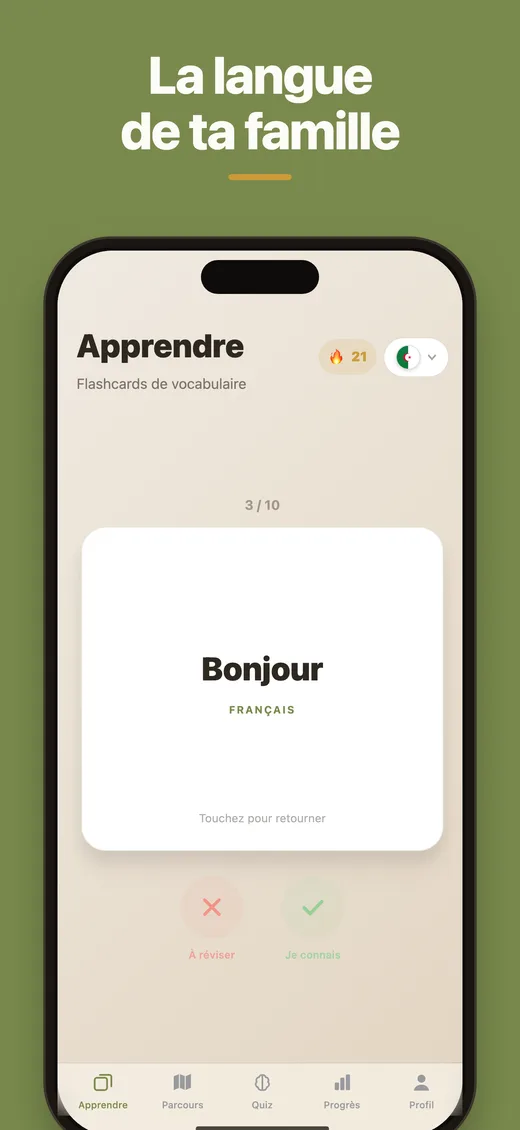
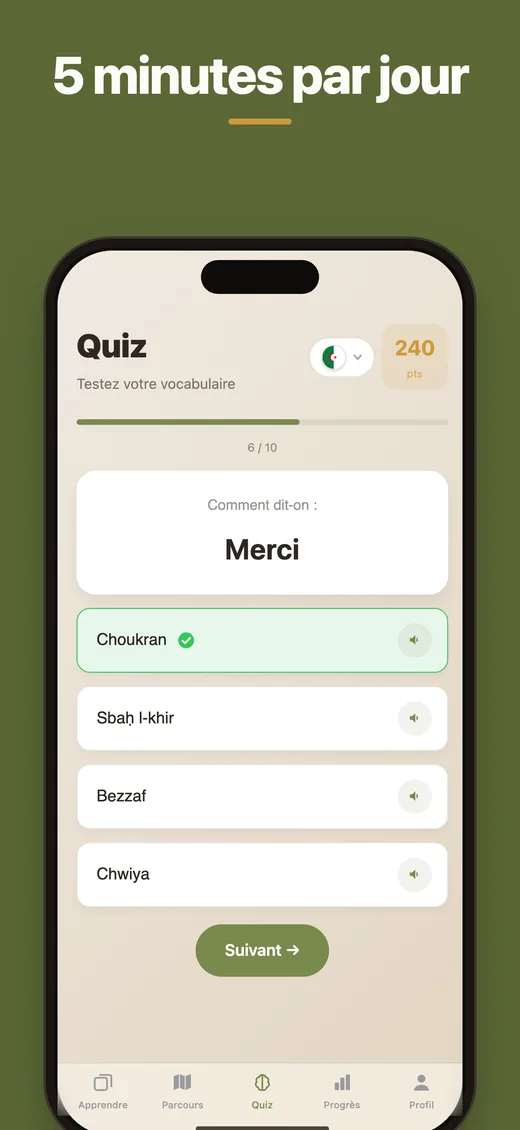
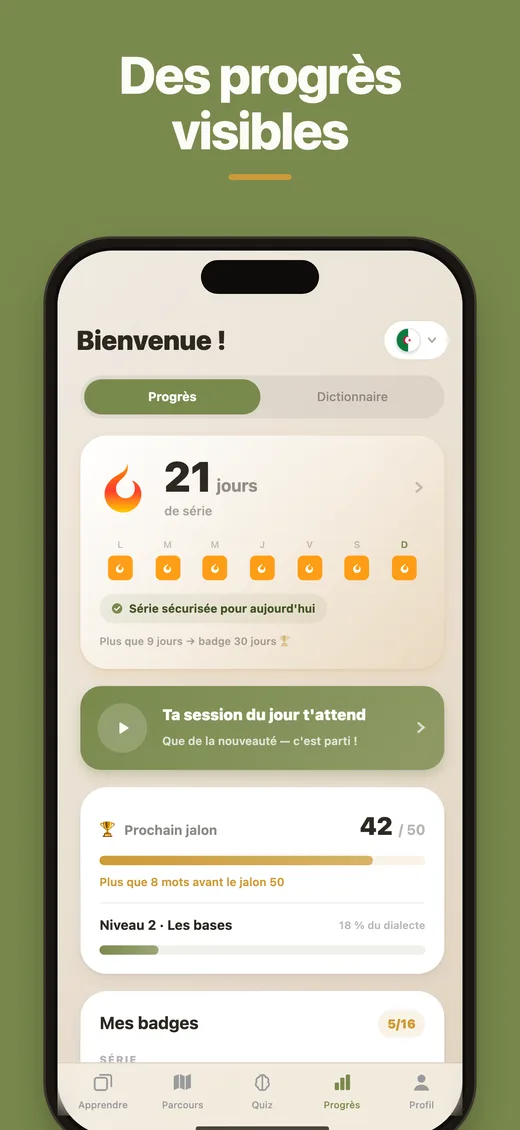
In concrete terms, for Turkish:
- Family vocabulary first: merhaba (hello), nasılsın? (how are you?), teşekkür ederim and its casual cousin sağol (thanks), anneanne and babaanne (the two grandmothers — maternal and paternal, which Turkish distinguishes), afiyet olsun (enjoy your meal). The words you already hear, finally pinned down.
- Clear audio on every word and every sentence, replayable at will: your ear absorbs vowel harmony and the letters ı ş ğ ç ö ü in context.
- Flashcards, quizzes and level-based tracks with spaced repetition: mastered words space out, hard ones come back at the right moment.
- 5-minute sessions, daily streaks, milestones (50, 100, 200 words…): built to fit a busy life, without guilt-tripping.
- Free to start, on iPhone and on the web.
An honest comparison of the alternatives
Turkish is well served by the big platforms — and they have real strengths. Here is the actual landscape in 2026:
| Solution | Strengths | Limits depending on your goal |
|---|---|---|
| Dialect | Everyday family vocabulary, spaced repetition, 5-min sessions, clear audio on every word and every sentence, designed for the diaspora, on iPhone, Android and web | No formal grammar course (suffixes are acquired through sentences, not theory lessons) |
| Duolingo | Complete, free Turkish course taught from English, well-built grammar progression, very motivating for some profiles | Heavily gamified universe (leagues, mascot) that doesn't suit everyone; a general course, not built around family conversation |
| Babbel | Structured Turkish lessons with grammar explanations, everyday-life situations | Subscription-based; longer, more school-like lessons, geared to travel and general life more than family conversation |
| Mondly and other generalists | Turkish available, varied thematic phrases | Identical content for every language in the catalog, with no cultural adaptation; limited memorization tracking |
| YouTube, podcasts, tandems | Free, real immersion, excellent Turkish-speaking creators; nothing replaces a real conversation | No structure and no planned reviews: perfect as a complement, insufficient on its own for durable memorization |
Let's say it plainly: if your project is a complete academic study of Turkish — explained grammar, writing, CEFR-style level progression — Duolingo or Babbel are good choices, proven by millions of learners. Dialect's ground is elsewhere: the living vocabulary of the family, 5 minutes a day.
Which solution for your profile?
- You're from the Turkish diaspora and want to talk with family: Dialect, starting with greetings and the vocabulary of family and meals. Add calls to your relatives — the best practice lab there is, and the most moving.
- You understand Turkish but don't speak it (third generation, it's very common): your ear is already trained; what you're missing is active vocabulary. Daily flashcards and quizzes quickly reactivate what lies dormant; our guide to learning your heritage language as an adult details this path.
- You're moving to Turkey to live, study or work: a structured course (Babbel, Duolingo or an institute) for grammar and writing, plus Dialect in parallel to anchor everyday speech.
- You're learning for a Turkish spouse or in-laws: start with the phrases that touch hearts — merhaba, nasılsınız? (the polite form), çok teşekkür ederim (thank you very much), afiyet olsun. A few weeks of Dialect are enough to make an impression at the first family meal.
- You just want a few words before a trip: our free guides (how to say hello in 15 languages) and a week or two of app practice cover the basics of politeness.
The method that works, whatever the app
An app is not everything: method is what makes you progress. Here is the one we recommend — and that Dialect orchestrates automatically:
- 5 to 10 minutes a day, every day. Consistency beats intensity, with no known exception in the research. For an agglutinative language, daily exposure to the same structures is what makes the suffixes feel natural.
- Audio from day one. Listen to each word several times, repeat out loud — vowel harmony is caught by imitating, not by analyzing.
- Trust the reviews. When teşekkür ederim comes back just as you thought you knew it, that is exactly when your memory needed it.
- Speak before you feel ready. From 50 words on, drop a merhaba, nasılsın? into a family call. Your grandparents' reaction will be worth all the badges.
Frequently asked questions
Duolingo or Dialect to learn Turkish?
They don't play in the same category. Duolingo offers a complete, free Turkish course with a solid grammar progression — in a heavily gamified universe. Dialect focuses on the everyday vocabulary of family life, in 5-minute sessions with spaced repetition. For a structured course from A to Z, Duolingo or Babbel are good choices; to reconnect with the family's language without spending hours on it, Dialect is more direct. And nothing stops you from combining the two.
Is Turkish difficult to learn?
Different rather than difficult. Agglutinative grammar and vowel harmony are disorienting at first, but Turkish is exceptionally regular: almost no exceptions, a Latin alphabet, spelling that reads exactly as it is written. With short daily practice, conversational basics come within a few months.
How long until you can hold a simple conversation?
With 5 to 10 minutes a day, count on 2 to 3 months for simple exchanges: greetings, family news, meals. Merhaba, nasılsın?, iyiyim (I'm fine), teşekkür ederim — the foundation comes quickly; the decisive factor is not talent, it's consistency.
I understand Turkish but I don't speak it: where should I start?
This is the most widespread situation in the third generation. Your comprehension is a huge head start: what you're missing is active vocabulary, not the ear. First reactivate the words of everyday family life with flashcards and quizzes, then push yourself to answer in Turkish — even three words — in family conversations. Starting over with a complete beginners' course would waste your advantage.
Is Dialect's Turkish audio recorded by native speakers?
No. For Turkish, Dialect uses a high-quality synthetic voice: every word and every example sentence comes with clear audio, replayable at will. Since Turkish has a very regular pronunciation that voice technology covers well, the result is faithful — but we would rather tell you that plainly than pretend to human recordings.
5 minutes a day · Free to start · 4.7/5 on the App Store
On a computer? Try the web app →