Best app to learn Kurdish in 2026
You're looking for an app to learn Kurdish — and more precisely Kurmanji, the variety spoken by the great majority of the diaspora — and you quickly discover the problem: neither Duolingo, nor Babbel, nor Rosetta Stone offers it. The few resources that do exist are often devoted to Sorani, the other main variety. For someone who wants to reconnect with the language of their family, the options are thin. This guide takes an honest tour of what actually exists, and helps you choose based on your profile.
Quick answer: to speak everyday Kurdish — the language of greetings, of family, of phone calls home — Dialect is the most direct app: Kurmanji in the Latin alphabet, every word recorded by a native speaker, spaced repetition and 5-minute sessions. Rated 4.7/5 on the App Store (August 2026). For a full grammar course, the Kurdish Institute of Paris and a few specialized apps are useful complements — details below.
Why Kurdish needs a dedicated app
Kurdish is neither Arabic nor Turkish
It's the most widespread misconception, and it deserves correcting right away: Kurdish is an Indo-European language, from the Iranian branch — the same broad family as English, French, German and Persian. It is related neither to Arabic (a Semitic language) nor to Turkish (a Turkic language), even though it has borrowed vocabulary from both over centuries of living side by side. The practical consequence: an Arabic or Turkish course will teach you nothing about Kurdish, and some Kurdish structures will even feel familiar to an English speaker. "How are you?" is tu çawa yî? — literally "you how are?" — with a conjugated verb "to be", just as in English.
Kurmanji or Sorani: two varieties, two alphabets
Kurdish is not monolithic. Kurmanji (or Northern Kurdish) is the most widely spoken variety: it is the Kurdish of Turkey and Syria, and therefore of most of the diaspora — in Germany and France above all, but also in the UK and North America. It is written in the Latin alphabet, with a few accented letters: ê, î, û, ş, ç. Sorani (Central Kurdish), spoken mainly in Iraq and Iran, is written in the Arabo-Persian script. The two varieties are not interchangeable — and many "Kurdish" resources found online actually teach Sorani, without always saying so. Check this point before committing: if your family comes from Diyarbakır, Mardin or Afrin, Kurmanji is what you need. It is the variety Dialect teaches.
A long-suppressed language, a fragile transmission
Kurdish was banned from public life for decades, particularly in Turkey, where its use in schools and media was long prohibited — down to the letters q, w and x, absent from the Turkish alphabet, which caused problems in official documents. Many diaspora parents grew up never reading or writing their own language, and transmission happened orally, when it happened at all. The result: many children of the diaspora understand a few words heard at home but can neither pronounce them with confidence nor string them together. Learning Kurmanji today means picking up the thread of an interrupted transmission — and for that, you need real recordings of native speakers, not a synthetic voice calibrated for another language.
The 4 criteria of a good Kurdish app
- Words recorded by a native Kurmanji speaker — not a synthetic voice. The long vowels ê, î, û and the consonants ş (sh) and ç (ch) are calibrated by ear, on real recordings.
- The right variety, clearly stated — Kurmanji in the Latin alphabet if your family comes from Turkey or Syria. A resource that says "Kurdish" without specifying may be teaching Sorani.
- A real memorization system — spaced repetition brings each word back at the optimal moment, just before you forget it. Without it, you retain about 20% of what you study.
- Short sessions and visible progress — 5 minutes a day kept up for 3 months beats an hour every Sunday abandoned in January. The app should make consistency easy (streaks, milestones, reminders).
Dialect in practice, with screenshots
Dialect was built precisely for this use case: diaspora members who want to speak their family's language again. Kurmanji Kurdish is one of its 19 rare languages — languages the major platforms ignore.
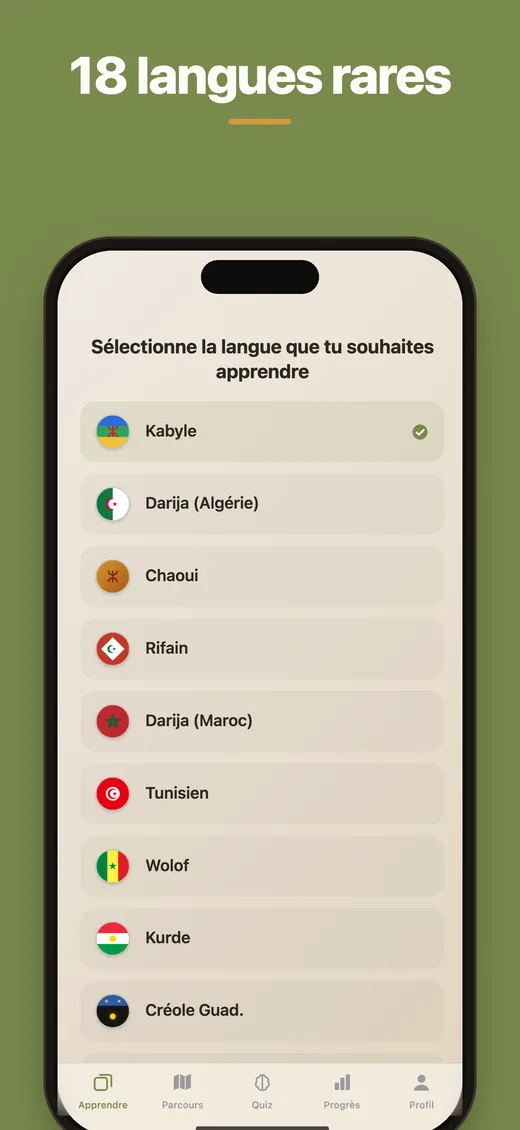
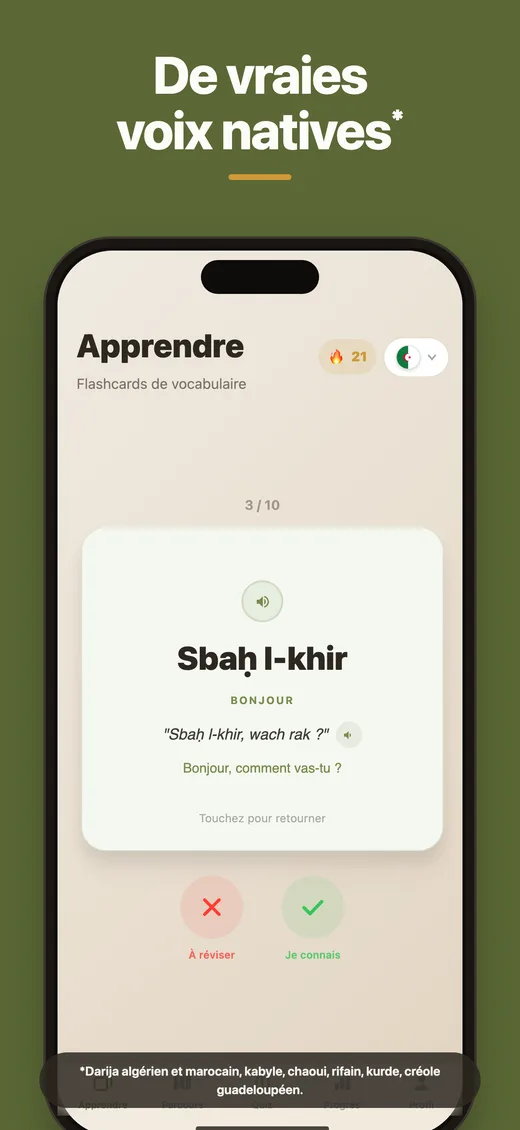
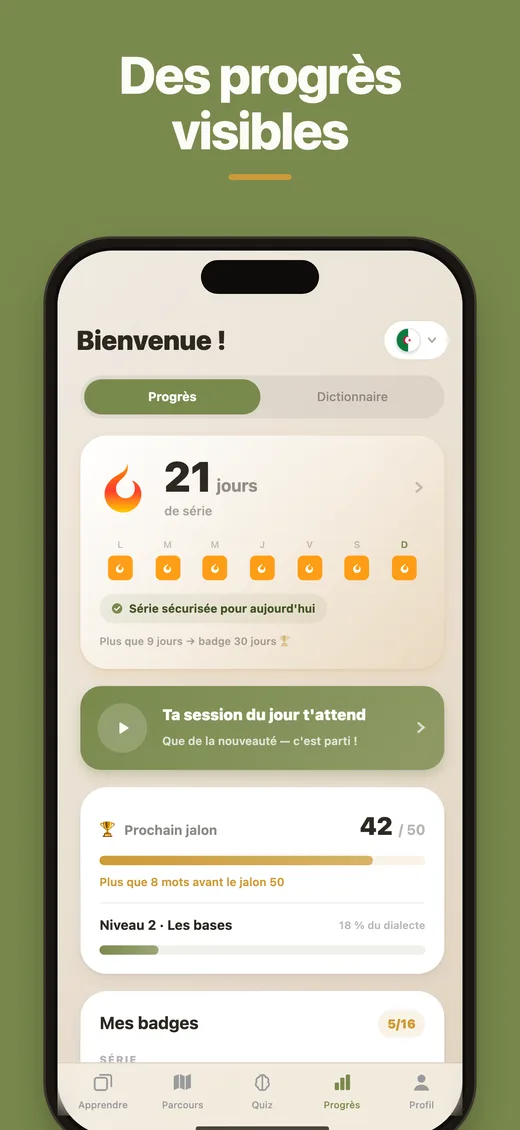
In concrete terms:
- Every Kurdish word recorded by a native speaker: a real recording, not text-to-speech. You hear the real ş of şev baş (good night) and the real length of the î in tu çawa yî?.
- Kurmanji in the Latin alphabet, the script of modern written Kurdish: silav (hello), spas (thank you), ez baş im (I'm fine). No Arabo-Persian script to learn: you can read from the very first session.
- Flashcards, quizzes and level-based tracks with spaced repetition: easy words space out, hard ones come back.
- 5-minute sessions, daily streaks, milestones (50, 100, 200 words…): built to fit a busy life.
- Free to start, on iPhone and on the web.
An honest comparison of the alternatives
No solution is perfect for everyone. Here is the real landscape in 2026:
| Solution | Strengths | Limits for Kurmanji |
|---|---|---|
| Dialect | Kurmanji with every word recorded by a native speaker, spaced repetition, 5-min sessions, designed for the diaspora, on iPhone, Android and web | No formal grammar course |
| Duolingo / Babbel / Rosetta Stone | Proven methods, huge catalogs | Do not offer Kurdish — neither Kurmanji nor Sorani |
| uTalk | Offers Kurmanji and Sorani separately, audio recorded by native speakers | Generic travel vocabulary (~2,500 words and phrases identical across all languages), no reviews scheduled over time |
| Dedicated Kurdish apps (Bimus, ZimanGo…) | Created by and for the Kurdish community, focused on Kurmanji (plus Zazaki for Bimus) | Interfaces mostly in Turkish, English or Kurdish; recent apps, content still being built; memorization tracking varies |
| Jûjî: Learn Kurdish | Kurmanji app with short exercises in listening, reading, writing and speaking from A1 to C1, a large dictionary with pronunciation recorded by native speakers, and conversation practice; free with in-app purchases (App Store listing) | Teaches Kurmanji: if your family speaks Sorani, look elsewhere; the full experience needs a subscription |
| Kurdish Institute of Paris | Structured Kurmanji and Sorani courses, in person and online, grammar and writing; enrollment every September | Fixed schedules and an academic pace, with courses taught in French: it takes regular availability and doesn't replace daily practice |
| YouTube / community decks | Largely free, real immersion, passionate Kurdish creators | Uneven coverage, Kurmanji and Sorani sometimes mixed, no review structure: a good complement, insufficient on its own |
Which solution for your profile?
- You're from the diaspora and want to talk with family: Dialect, starting with greetings and family vocabulary. Add calls to your relatives — the best practice lab there is, and the most moving.
- You're aiming for grammar and writing (reading the Kurdish press, writing correctly): a structured course like those of the Kurdish Institute of Paris, with Dialect alongside to anchor vocabulary day by day.
- Your family speaks Sorani (Iraq, Iran): Dialect teaches Kurmanji; turn to uTalk (which offers both varieties) or a Sorani course. Don't learn Kurmanji "by default" if the people around you speak Sorani.
- You just want a few words out of respect or before a trip: our free guides (how to say hello in 15 languages) and a week of Dialect are enough for the basics of politeness — silav, spas, bi xatirê te (goodbye).
The method that works, whatever the app
An app is not everything: method is what makes you progress. Here is the one we recommend — and that Dialect orchestrates automatically:
- 5 to 10 minutes a day, every day. Consistency beats intensity, with no known exception in the research.
- Audio from day one. Listen to each word several times, repeat out loud — the sounds ş, ç and the long vowels settle in through imitation, not through reading.
- Trust the reviews. When a word comes back just as you thought you knew it, that is exactly when your memory needed it.
- Speak before you feel ready. From 50 words on, drop silav and gelek spas (thank you very much) into a family call. For a language that survived decades of prohibition, every word spoken by the new generation counts double.
Frequently asked questions
Kurmanji or Sorani: which variety of Kurdish should you learn?
Kurmanji is the most widely spoken variety: it is the Kurdish of Turkey and Syria, and of most of the diaspora in Europe, and it is written in the Latin alphabet. Sorani, spoken mainly in Iraq and Iran, is written in the Arabo-Persian script. Choose based on where your family comes from. Dialect teaches Kurmanji.
Can you learn Kurdish with Duolingo or Babbel?
No. Neither Duolingo nor Babbel offers Kurdish, in any variety. The few resources that do exist are often centered on Sorani; Dialect teaches Kurmanji.
Is Kurdish close to Arabic or Turkish?
No — and the confusion is common. Kurdish is an Indo-European language of the Iranian branch, related to Persian. It has borrowed vocabulary from Arabic and Turkish, but its grammar and core lexicon are quite distinct: structurally, it is closer to English than to Arabic (a Semitic language) or Turkish (a Turkic language).
How long until you can hold a simple exchange in Kurdish?
With 5 to 10 minutes a day, count on 2 to 3 months to place your first simple exchanges: silav, tu çawa yî?, ez baş im, spas. The decisive factor is not talent — it's consistency.
Are Dialect's Kurdish words recorded by a real speaker?
Yes — every Kurdish word is recorded by a native Kurmanji speaker, not by a text-to-speech engine. That is essential for acquiring the real pronunciation of the long vowels ê, î, û and the consonants ş and ç — and it's the #1 criterion we advise you to check everywhere else.
5 minutes a day · Words recorded by a native speaker · 4.7/5 on the App Store
On a computer? Try the web app →