Why learn hieroglyphs?
Standing in front of a stela at the Louvre or the British Museum, a carved cartouche is, for most visitors, just a beautiful drawing. With a few dozen signs in your head, it becomes a king's name, a wish for life or an offering formula — and the museum changes completely.
Whether you are fascinated by Ancient Egypt, the parent of a child obsessed with pharaohs, or simply curious after a documentary, Dialect gives you the first words to go from decoration to text.
The Dialect Method
Our app applies to hieroglyphs the same rigor as to our living languages:
- Emblematic vocabulary: 115 attested Middle Egyptian words — ankh, nefer, hotep, the gods, the family, the animals of the Nile.
- Real signs: every word is displayed with its Unicode hieroglyphs and its scholarly transliteration (ꜥnḫ, nfr, ḥtp).
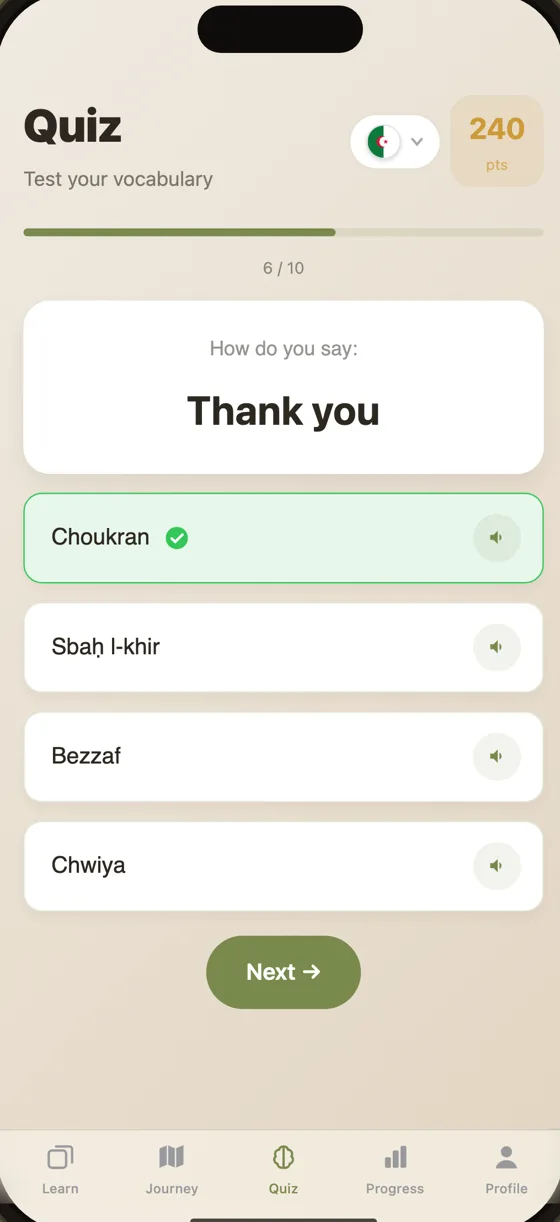
- Interactive quizzes: recognize the signs, match them to their meaning, track your progress.
- Review mode: never lose what you've already learned.
The Science Behind Dialect
Memorizing signs is exactly the problem spaced repetition solves best:
- Spaced Repetition System (SRS): our algorithm brings each sign back right before you would forget it — the method proven on Japanese kanji works just as well for the owl 𓅓 and the horned viper 𓆑. How spaced repetition works.
- Scientific honesty: no invented audio for a dead language. Egyptologists' transliteration and written conventional readings, nothing romanticized.
- Granular learning: short sessions, sign by sign, word by word, to prevent cognitive overload.
Hieroglyphs in a few facts
- What they are: the monumental script of the Ancient Egyptian language, in use from about 3200 BC to about 400 AD — nearly 3,600 years.
- Decipherment: by Jean-François Champollion in 1822, thanks to the Rosetta Stone and its three versions of the same text.
- Three families of signs: ideograms (the sign depicts the thing), phonograms (the sign records a sound) and determinatives (silent signs that indicate the word's category).
- Standard reference: Gardiner's sign list, which organizes the signs by category (men, birds, buildings…), remains the classification Egyptologists use.
One essential point of honesty: Egyptian writing records mainly consonants. The scholarly transliteration is written ꜥnḫ, nfr, ḥtp; the readings "ankh", "nefer", "hotep" are Egyptologists' conventions, not the real pronunciation, which is reconstructed and partly lost. Dialect owns that fact instead of papering over it.
10 essential words in hieroglyphs
Here are the first words to know — the ones you will meet most often on stelae and cartouches. Real signs, transliteration, conventional reading:
| English | Hieroglyphs | Transliteration | Convention |
|---|---|---|---|
| life | 𓋹𓈖𓐍 | ꜥnḫ | ankh |
| beautiful, good | 𓄤𓆑𓂋 | nfr | nefer |
| peace, to be content | 𓊵𓏏𓊪 | ḥtp | hotep |
| Egypt (the black land) | 𓆎𓅓𓏏𓊖 | kmt | Kemet |
| sun, Ra | 𓇳𓏤 | rꜥ | Ra |
| god | 𓊹 | nṯr | netjer |
| house | 𓉐𓏤 | pr | per |
| pharaoh (the Great House) | 𓉐𓉻 | pr-ꜥꜣ | per-aa |
| truth, Maat | 𓐙𓂝𓏏𓆄 | mꜣꜥt | Maat |
| scribe | 𓏞𓀀 | zẖꜣw | sekhau |
The Dialect app covers 115 attested Middle Egyptian words, organized by theme (gods and royalty, family, body, animals of the Nile, royal formulas…). The "Convention" column gives the Egyptologists' customary reading, not the actual ancient pronunciation.
How Dialect makes learning hieroglyphs easier
Learning hieroglyphs on your own comes with very specific obstacles: intimidating university grammars, specialized fonts to install, and above all hundreds of signs that all look alike when you start. Dialect was built to flatten that first step.
Specifically for Ancient Egyptian, the app provides:
- Progress through emblematic words: you first learn what you will actually see again in a museum — ankh, the royal cartouches, the offering formula hetep di nesut.
- Signs displayed in real Unicode: no blurry images — the hieroglyphs of the international standard, with their transliteration.
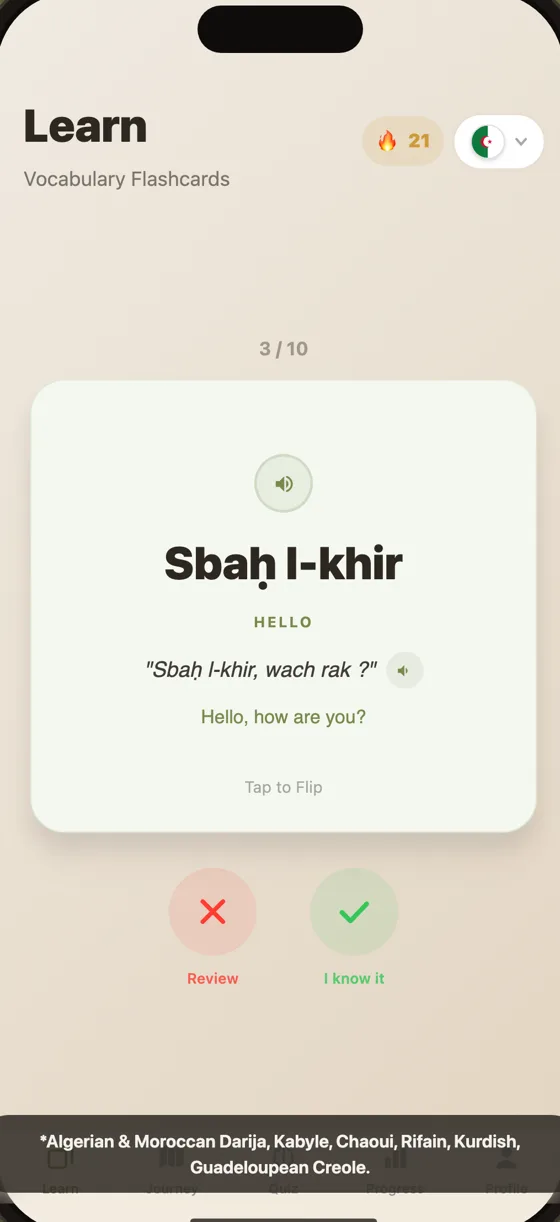
- Short sessions (5 cards a day): consistency beats intensity for anchoring visual signs in long-term memory.
- Smart review: the spaced repetition algorithm brings each sign back right before you forget it.
The goal is not to turn you into an Egyptologist, but to let you recognize and read the key words of a stela, a cartouche or a sarcophagus — and impress everyone on your next museum visit.
Start with your name, like Champollion
It was by recognizing the names of Ptolemy and Cleopatra inside their cartouches that Champollion cracked the code in 1822. Take the same first step: our free tool transcribes your first name into phonetic signs, inside a royal cartouche, with a sound-by-sound breakdown (tool in French — the cartouche speaks for itself).
Frequently asked questions about learning hieroglyphs
How do you write "life" in hieroglyphs?
Life is written 𓋹𓈖𓐍 (transliteration ꜥnḫ, conventional reading "ankh"). The first sign is the ankh cross, the symbol of life that gods hold out to pharaohs on temple reliefs.
How were hieroglyphs pronounced?
Nobody knows exactly. Egyptian writing records mainly consonants, not vowels: the real pronunciation is reconstructed and uncertain. Readings like "ankh", "nefer" or "hotep" are conventional vocalizations that Egyptologists worldwide use so the texts can be read aloud.
Is the Dialect app free?
Dialect is free to start: every day you get one session, one quiz and the Greetings lesson of the Path. Premium unlocks everything.
Is there audio for Ancient Egyptian in Dialect?
No, deliberately. Ancient Egyptian is a dead language whose exact pronunciation is lost: offering audio would be making things up. Dialect shows every word with its real hieroglyphic signs, its scholarly transliteration and its written conventional reading.
Do I need any background in Egyptology to start?
No. Dialect starts from zero: the most frequent signs, the emblematic words (ankh, nefer, hotep, Kemet…) and then the royal formulas. No prerequisites required.
Is Dialect available on Android?
Yes. The app is on Google Play. On desktop, Dialect runs directly in your browser through the web app (mydialect.io/app): same languages, same audio, same account. The native app is available on iPhone and iPad from the App Store.
In short: Why choose Dialect?
Dialect is the simplest app to start reading Egyptian hieroglyphs: 115 attested words displayed in real Unicode signs with their transliteration, a spaced repetition algorithm to memorize them for good, and a free tool to write your name inside a royal cartouche.
Discover other languages on Dialect
Alongside Ancient Egyptian, Dialect offers 15 living heritage languages to reconnect with your roots:
Start for free, today
Free daily session. On iPhone via the App Store, on Android via Google Play, or straight in the browser on desktop.

 Scan with your phone · iPhone or Android
On a computer?
Open the web application