Why learn Tachelhit?
Tachelhit — also spelled Tashelhit, called Shilha in older English sources and chleuh in French — is the Amazigh (Berber) language of south-western Morocco. You hear it in Agadir, Tiznit and Taroudant, and in the villages of the Anti-Atlas and the western High Atlas. With several million speakers, it is the most widely spoken Amazigh language in the country.
It has travelled too: to Morocco's big cities, and with the diaspora to France, Belgium and the Netherlands. Many children and grandchildren understand it but don't dare speak it. That is what Dialect is for: getting the words of home back, out loud, a few minutes a day.
The Dialect method for Tachelhit
Everything starts from speech and from the vocabulary people actually use:
- 989 words and phrases: grouped by theme: greetings, family, home, cooking, numbers, the market, feelings…
- A real voice: words and their example sentences are studio-recorded by Khalid, a Tachelhit speaker. No synthetic voice.
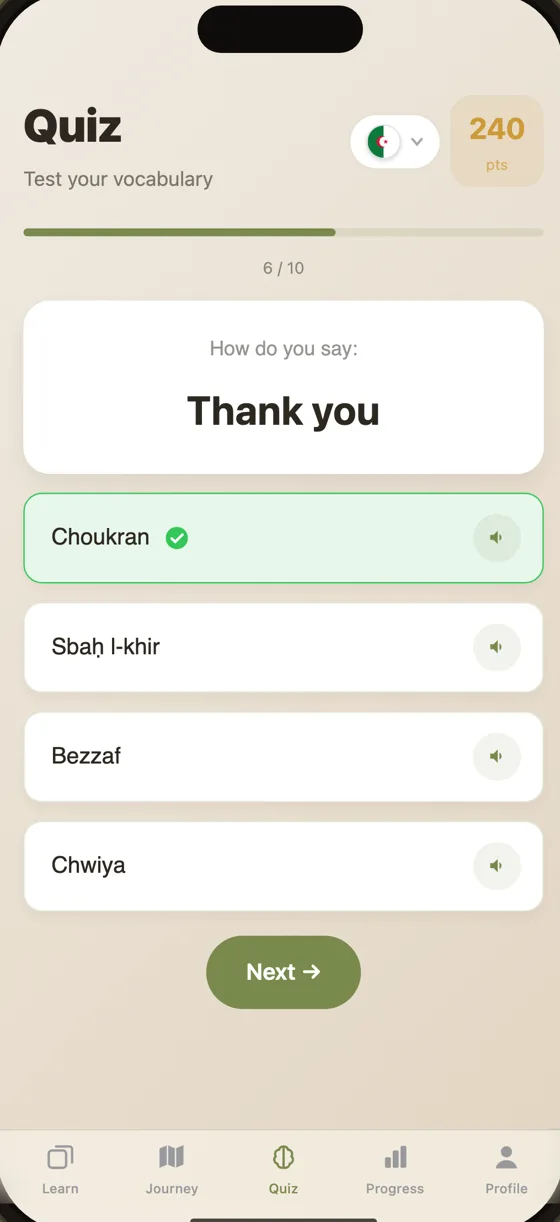
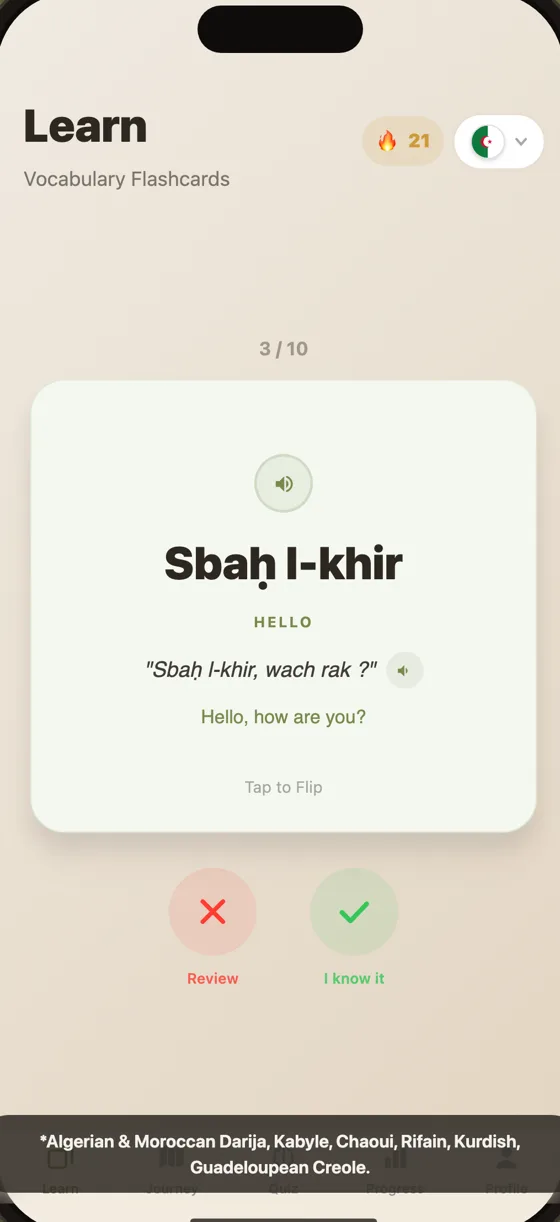
- A 62-unit Path: plus flashcards and quizzes, to move step by step from your first “azul” to full sentences.
- Spaced repetition: each word comes back right before you would forget it, so it sticks.
Learning Tachelhit: the essentials
Duolingo, Babbel and Rosetta Stone do not offer a Tachelhit course, and structured resources with audio remain rare outside universities. Dialect covers Tachelhit with 989 words and phrases, their example sentences and a 62-unit Path, recorded by a native speaker and reviewed with spaced repetition. Dialect is free to start, with one session a day, on iPhone and iPad, and in the browser on Android and desktop.
Tachelhit in a few facts
- Language family: Amazigh (Berber), part of the Afro-Asiatic family.
- Speakers: several million; the most widely spoken Amazigh language in Morocco.
- Regions: the Souss plain (Agadir, Taroudant), Tiznit, the Anti-Atlas and the western High Atlas; a diaspora in France, Belgium and the Netherlands.
- Names: Tachelhit or Tashelhit, Tasoussit for the Souss, Shilha in English, chleuh in French.
- Writing: Tifinagh, the official script for Amazigh in Morocco, and the Latin alphabet; there is also an old written tradition in Arabic script.
Amazigh has been an official language of Morocco since the 2011 Constitution, alongside Arabic. In Dialect, Tachelhit is written in Latin letters, in an easy-to-read spelling (gh, kh, ch), with a few dotted letters such as ḍ, ḥ or ẓ for sounds English does not have.
10 everyday Tachelhit words, with translation
The vocabulary of home and the market. The right-hand column gives a full sentence in Tachelhit, exactly as it appears in the app, with its translation.
| English | Tachelhit | Example |
|---|---|---|
| water | aman | Fk-iyi aman. Give me water. |
| bread | aghrum | Aghrum irgha. The bread is hot. |
| tea | atay | Skar atay. Make the tea. |
| house | tigmmi | Tigmmi tmqqor. The house is big. |
| mother | ina | Ina t la ghonwal. My mother is in the kitchen. |
| father | iba | Iba aritkhdam. My father is at work |
| brother | gma | Gma imqor. My brother is tall |
| friend | amddakkul | Amddakkul inu yuchkad. My friend came to visit |
| market | ssuq | Nra a nddu s ssuq. We're going to the market. |
| mountain | adrar | Adrar ighzzif. The mountain is very high |
Tachelhit is famous among linguists for words written without any vowel. In the app, skr (to do), gn (to sleep), nkr (to get up) and sfld (to listen) are spelled just like that. One more reason to hear them before you read them.
Hello, thank you, goodbye: essential phrases in Tachelhit
How do you say hello in Tachelhit, thank you or goodbye? Here are the basics. Tap Listen to hear each one, spoken by a native Tachelhit speaker:
| English | Tachelhit | Listen |
|---|---|---|
| hello | azul | |
| hi | azul flawn | |
| how are you | mank antguit | |
| thank you | tanmmirt | |
| yes | yyih | |
| no | uhu | |
| sorry | surfiyi | |
| welcome | mrrḥba | |
| goodbye | hakin ghina | |
| see you tomorrow | ar askka |
Audio recorded by a native Tachelhit speaker, with no synthetic voice. For all 989 words, their sentences and the Path, download the Dialect app or open the web app on Android and desktop.
Why it stays in your memory
Three simple principles, applied in every session:
- Spaced repetition (SRS): the app works out the right moment to show you a word again — not too early, not too late.
- Ear first: you hear the word, then its sentence, before you read it. Tachelhit is learned by listening.
- Small units: a few cards per session, so you can learn every day without overload.
Guides to learn Tachelhit
Frequently asked questions about learning Tachelhit
How do you say hello in Tachelhit?
In Tachelhit, “hello” is “azul”. To follow up: “Azul, manzakin?” (hello, how are you?). “Thank you” is “tanmmirt” and “goodbye” is “hakin ghina”.
Are Tachelhit, Tashelhit and Shilha the same language?
Yes. Tachelhit and Tashelhit are two spellings of the language's own name; Shilha is the older English name, chleuh the French one, and Tasoussit refers to the Souss, its heartland.
Is Tachelhit a dialect of Arabic?
No. Tachelhit is an Amazigh (Berber) language, from a different family than Moroccan Darija, which is a variety of Arabic. The two have lived side by side for a long time and share loanwords, but Tachelhit grammar and most of its vocabulary are Amazigh.
Is Dialect free?
Dialect is free to start, with a daily session of 5 cards per language. The Premium subscription unlocks unlimited sessions and access to all languages.
Who records the Tachelhit audio in Dialect?
Khalid, a Tachelhit speaker, recorded in a studio. There is no synthetic voice: you hear the language as it is spoken.
Is Dialect available on Android?
Yes. On Android and on desktop, Dialect runs directly in your browser through the web app (mydialect.io/app): same languages, same audio, same account. The native app is available on iPhone and iPad from the App Store.
Discover other languages on Dialect
Dialect also teaches other heritage languages, to reconnect with your roots:
Start for free, today
Free daily session. On iPhone via the App Store, or straight in the browser on Android and desktop.

 Scan with your iPhone
On Android or desktop?
Open the web application