Best app to learn Tachelhit in 2026
You are looking for an app to learn Tachelhit — also written Tashelhit, and called Shilha in older English sources — the Amazigh language of the Souss, in south-western Morocco. You quickly find that the choice is thin. Duolingo, Babbel, Rosetta Stone: none of the big platforms offers Tachelhit. Yet it is the most widely spoken Amazigh language in Morocco, with several million speakers. This guide looks at what really exists and helps you choose.
Quick answer: to speak everyday Tachelhit — the language of family in Agadir, Tiznit or Taroudant, of Sunday phone calls and summers in the village — Dialect offers 989 words and phrases, their example sentences and a 62-unit Path, with the voice of a native Tachelhit speaker recorded in a studio and no synthetic voice. Spaced repetition, 5-minute sessions, rated 4.7/5 on the App Store. For in-depth grammar, a course with a teacher remains the best complement — details below.
Why Tachelhit needs a dedicated app
Neither Darija nor a "generic Berber"
Tachelhit is not a dialect of Arabic. It is an Amazigh (Berber) language, from a different family than Moroccan Darija. The two have lived side by side for a long time and share loanwords, but an Arabic course, even a Moroccan one, will not teach you to say “Azul, manzakin?”.
Nor is Tachelhit interchangeable with the other Amazigh languages. Kabyle, Chaoui and Central Atlas Tamazight share a common stock with it, but mutual understanding takes practice. A "Berber" course that doesn't say which Berber may be teaching the language of another region. If your family comes from the Souss, the Anti-Atlas or the western High Atlas, Tachelhit is the one you need.
A language you learn by ear
Tachelhit is famous among linguists for words with no vowel at all: in Dialect, skr (to do), gn (to sleep) and ẓr (to see) are written just like that. Add consonants English doesn't have, written ḍ, ḥ, ẓ or gh. No transcription replaces listening: these words stick when you hear them from someone whose language it is, several times, in real sentences.
A family language with little digital presence
Tachelhit is passed on at home first. In Morocco's big cities and in the diaspora — France, Belgium, the Netherlands — that chain weakens: grandparents speak it, parents understand it, children sometimes keep only a few words. There is no school class and no big platform to take over. A dedicated app is one of the few structured tools for relearning your parents' language at your own pace.
The 4 criteria of a good Tachelhit app
- A real Tachelhit voice — not a synthetic voice, not a speaker of another Amazigh language. Your ear tunes itself to what it hears.
- Everyday vocabulary first — greetings, family, meals, the market. You are learning to say azul to your grandmother and understand her answer.
- A real memory system — spaced repetition brings each word back right before you forget it. Without it, a vocabulary list evaporates in a few weeks.
- Short sessions and visible progress — five minutes a day kept up for three months beats an hour on Sundays abandoned after three weeks.
Dialect in practice
Dialect was built for exactly this: getting your family's language back, out loud. Tachelhit is treated as a language in its own right, distinct from Kabyle, Chaoui and Darija.
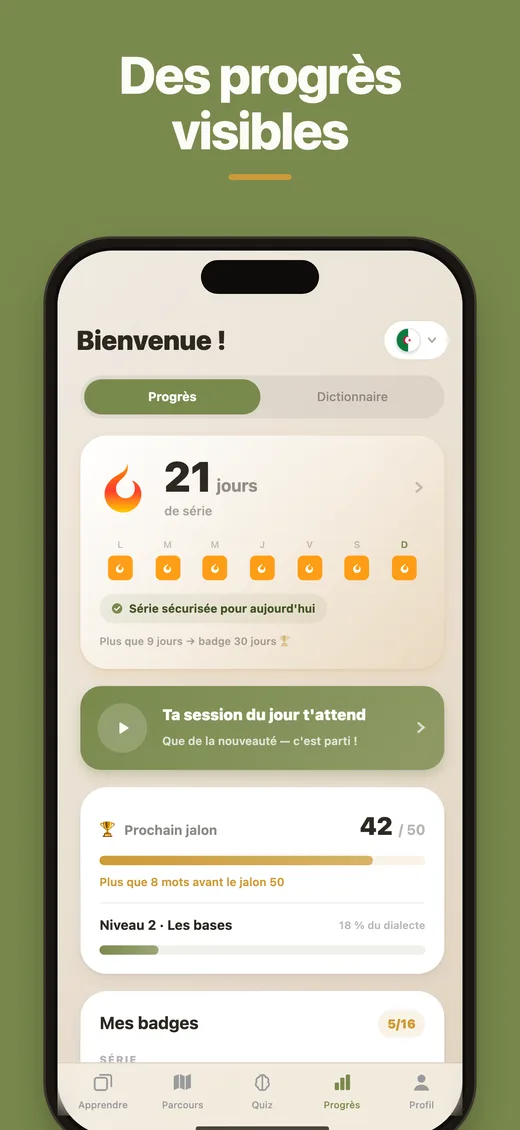
In concrete terms:
- 989 words and phrases, each with an example sentence, grouped by everyday themes.
- The voice of Khalid, a Tachelhit speaker, studio-recorded for words and sentences alike. No synthetic voice.
- A 62-unit Path, flashcards and quizzes, with spaced repetition: words you know space out, stubborn ones come back more often.
- A Latin spelling you can read right away: azul, tanmmirt, aghrum. Tifinagh can come later.
- Free to start, on iPhone and, through the web app, on Android and desktop.
An honest comparison of the alternatives
| Solution | Strengths | Limits for Tachelhit |
|---|---|---|
| Dialect | 989 words and sentences spoken by a native Tachelhit speaker, 62-unit Path, spaced repetition, 5-minute sessions | No formal grammar course; native app on iPhone and iPad, web app on Android and desktop |
| Duolingo / Babbel / Rosetta Stone | Proven methods, large catalogues | Do not offer Tachelhit. Their "Arabic" is Modern Standard Arabic, which does not help you understand Tachelhit |
| University and community classes | Real teachers, grammar explained, a framework | Fixed schedules, a long commitment, few options outside a handful of cities: an excellent complement, harder to sustain on its own |
| Videos, dictionaries and community resources | Often free, made by enthusiasts, good for the ear and the culture | No progression or organised review, uneven quality: valuable as a supplement, not enough alone |
Which solution for your situation?
- Your family comes from the Souss and you want to talk with them: Dialect, starting with greetings and family vocabulary. And call your relatives: nothing replaces a real conversation.
- You also want grammar in depth: Dialect for the spoken foundation and memorisation, plus a course with a teacher for conjugation and syntax.
- Your family is Amazigh, but from another region: don't learn Tachelhit by default. Check which language your family actually speaks first.
The method that works, whatever the app
- Five to ten minutes a day, every day. For a language you don't hear in the street, consistency matters more than anything.
- Audio from day one. Listen to each word several times and repeat it out loud.
- Trust the reviews. When a word comes back although you thought you knew it, that is exactly when your memory needed it.
- Speak before you feel ready. From your very first words, drop azul and tanmmirt into a family call.
Frequently asked questions
Can you learn Tachelhit with Duolingo or Babbel?
No. Neither Duolingo, Babbel nor Rosetta Stone offers Tachelhit. Their Arabic courses teach Modern Standard Arabic, which belongs to a different language family and will not help you follow a conversation in Tachelhit.
Tachelhit or Moroccan Darija: which should you learn?
They are two different languages: Tachelhit is Amazigh (Berber), Darija is a variety of Arabic. If your family comes from the Souss and speaks Tachelhit at home, start with Tachelhit; Darija, Morocco's lingua franca, can come next.
Is Tachelhit written in Tifinagh, Arabic script or Latin letters?
All three exist. Tifinagh is the official script for Amazigh in Morocco, Tachelhit has an old written tradition in Arabic script, and Latin letters are widely used. Dialect uses a simple Latin spelling, so you can speak first.
Tachelhit, Tashelhit, Shilha: what is the difference?
None in substance: Tachelhit and Tashelhit are two spellings of the language's own name, Shilha is the older English name, and Tasoussit refers to the Souss, its heartland.
Is Dialect's Tachelhit audio a real voice?
Yes. Tachelhit words and example sentences are studio-recorded by Khalid, a Tachelhit speaker, with no synthetic voice.
5 minutes a day · A native Tachelhit voice · 4.7/5 on the App Store
On Android or desktop? Try the web app →